7 common questions about lower back pain at Valley Chiropractic.
Lower back pain is one of the most common reasons Mountain House residents call our office. Between long commutes over the Altamont, desk jobs in Tri-Valley tech, and weekend yard work in Wicklund and Questa, the lumbar spine takes a beating. Most episodes settle down on their own, but some need hands-on care, and a few point to something more serious.
This FAQ answers the low back pain questions we hear most often from Mountain House patients. You will find plain-language guidance on causes, safe home remedies, red flags that mean urgent care, and when to see a chiropractor for back pain. If you are unsure where you fit, call our Mountain House office and we will help you figure out the next step.
What causes lower back pain in Mountain House commuters?
Most lower back pain in Mountain House commuters comes from prolonged sitting, poor lumbar support, and repetitive strain, not a single dramatic injury. When you sit for 60 to 90 minutes each way on I-580 or the ACE train, the discs in your lumbar spine load unevenly, the hip flexors tighten, and the deep core muscles switch off. Add a laptop-heavy workday in Pleasanton or San Francisco and the pattern repeats for 10 to 12 hours a day.
Common mechanical drivers we see at our Mountain House and [Tracy](/locations/tracy) offices include:
- Disc irritation or bulges from sustained flexed posture in the car
- Sacroiliac joint dysfunction from stepping in and out of a truck or SUV
- Facet joint sprains from twisting to grab a bag from the back seat
- Gluteal and hip weakness that forces the low back to overwork
- Old sports injuries from high school or rec league that never fully rehabbed
Lifestyle factors matter too. Dehydration on long drives, skipping lunch, and doing weekend warrior yard work in a Wicklund backyard after five sedentary days will amplify any of the above. According to the National Institute of Neurological Disorders and Stroke, most low back pain is mechanical and related to how the spine, muscles, discs, and nerves move together, not to a single disease process.
We wrote a deeper piece specifically for this population at [Lower Back Pain in Mountain House Commuters](/blog/lower-back-pain-mountain-house-commuters). If your pain is worse on Monday morning and eases by Friday evening, your commute is almost certainly part of the story, and a mix of [chiropractic care](/services/chiropractic-care) and daily movement usually helps.
What home remedies for low back pain actually work?
For a typical flare, the best home remedies for low back pain are gentle movement, short-term ice or heat, over-the-counter pain relievers if appropriate for you, and sleep positioning that unloads the spine. Strict bed rest is not recommended and can actually slow recovery, according to guidance summarized by the [NIH National Institute of Neurological Disorders and Stroke](https://www.ninds.nih.gov/health-information/disorders/back-pain).
Here is what we tell Mountain House patients to try in the first 48 to 72 hours:
1. Keep moving in small doses. Walk 5 to 10 minutes every hour or two around the Central Park loop or your neighborhood.
2. Use ice for the first day or two if the pain feels sharp or swollen, then switch to heat for muscle guarding.
3. Sleep on your side with a pillow between your knees, or on your back with a pillow under your knees.
4. Do gentle range of motion: knee-to-chest, pelvic tilts, cat-cow, and a short walk after dinner.
5. Cut back, but do not stop, normal activities. Motion is lotion for the lumbar spine.
Avoid deep forward bending, heavy lifting, long car rides if you can, and prolonged sitting on a soft couch. Those all reload the discs in ways that keep you stuck.
If you are not clearly better in 5 to 7 days, or if the pain is spreading into your leg, it is time to get evaluated. Home care is a great first step, but it is not a substitute for a hands-on exam. Many of our patients pair home strategies with in-office [chiropractic techniques](/services/chiropractic-techniques) and targeted [massage therapy](/services/massage-therapy) to speed recovery and prevent the next flare.
What are the back pain red flags that mean I should skip the chiropractor and go to urgent care or the ER?
Go directly to urgent care or the emergency room if your back pain comes with any of these red flags: loss of bladder or bowel control, numbness in the groin or inner thighs (saddle anesthesia), progressive weakness in one or both legs, fever with back pain, unexplained weight loss, or pain after a major trauma like a car crash or a fall from height. These can point to cauda equina syndrome, infection, fracture, or other conditions that need imaging and medical management right away.
The American College of Physicians and multiple peer-reviewed guidelines list these as classic red flag symptoms that require urgent workup, not conservative care first. You can read more about our approach to sorting emergencies at [Chiropractic Emergencies: When to Seek Urgent Care or the ER Instead](/faq/chiropractic-emergencies-when-to-seek-urgent-care-or-the-er-instead).
Yellow flags, which mean call us soon but not necessarily 911, include:
- Pain that shoots below the knee and is getting worse
- Numbness or tingling in the foot
- Night pain that wakes you up regularly
- History of cancer, long-term steroid use, or IV drug use
- Back pain in someone over 70 with no clear trigger
For the average Mountain House adult with a stiff, achy low back after a long week of driving and desk work, red flags are rare. Most cases are mechanical and respond well to conservative care. But we would rather you call and ask than guess wrong. Dr. Durant and the team can usually tell within a few minutes of a phone triage whether you need our office, your primary care doctor, or the ER. When in doubt, dial 911 or head to the nearest emergency room first, and we can help with rehab afterward.
When should I see a chiropractor for back pain instead of waiting it out?
See a chiropractor for back pain if it has lasted more than a week, keeps coming back, limits work or sleep, or involves any leg symptoms like tingling or shooting pain. You do not need to wait until you are miserable. Earlier care usually means fewer visits and a faster return to normal activity.
Specific signals that it is time to book an evaluation:
- Pain that is the same or worse after 5 to 7 days of home care
- Repeat flares every few months in the same spot
- Stiffness that makes it hard to put on socks or get out of the car
- Pain that radiates into the buttock, thigh, or calf
- A recent fender bender on I-205 or Grant Line Road, even if you felt fine at the scene
The American Chiropractic Association notes that spinal manipulation is a well-established, evidence-informed option for acute and chronic low back pain, and clinical guidelines from the [American College of Physicians](https://www.acpjournals.org/doi/10.7326/M16-2367) list spinal manipulation among first-line, non-drug treatments to consider before medication for many patients with low back pain.
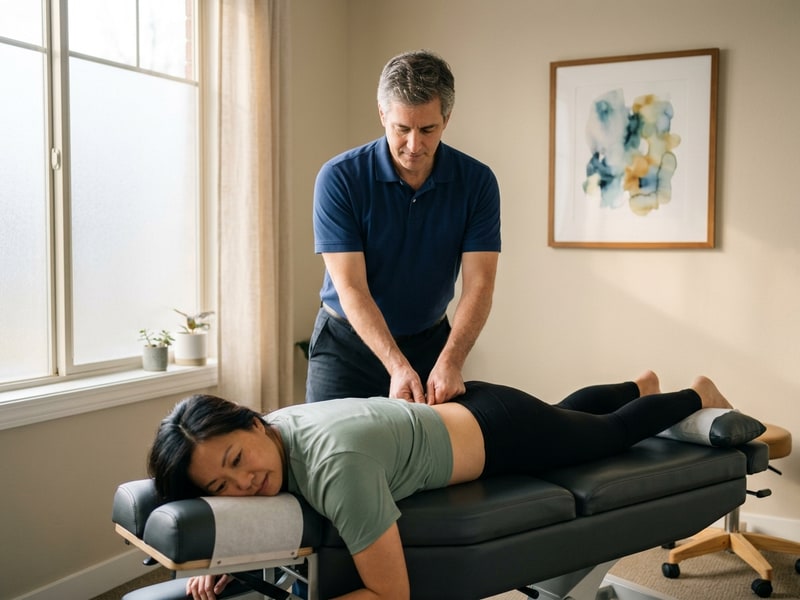
At Valley Chiropractic, a first visit includes a full history, orthopedic and neurologic exam, and a clear explanation of what we find. If your case looks like a disc issue we will say so and may refer for imaging, and if it looks like simple mechanical strain we usually start care the same day. You can learn what to expect at [What Happens at Your First Chiropractic Visit](/blog/what-happens-first-chiropractic-visit). For crash-related back pain, our [auto accident injury](/services/auto-accident-injury) team handles the paperwork so you can focus on healing.
How do I know if my lower back pain is a disc problem or just a muscle strain?
The quickest tell is where the pain travels. A muscle strain usually stays in the low back and glutes, feels achy or tight, and eases with movement and heat. A disc problem more often sends sharp, electric, or burning pain down the leg past the knee, and it tends to get worse with sitting, bending forward, coughing, or sneezing.
Other clues that point toward a disc:
- Numbness or tingling in a specific part of the leg or foot
- Weakness lifting the foot or pushing off the toes
- Pain that is worse in the morning after sleep and eases with a short walk
- A recent lifting or twisting injury that felt like a pop
Muscle strain clues usually include:
- Diffuse soreness across the low back
- Tenderness when you press on the muscles
- No leg symptoms
- Improvement within a few days of gentle movement
The tricky part is that both can happen at the same time, and the exam matters. We use orthopedic tests, reflexes, strength testing, and sensation checks to sort it out. If needed, we refer for MRI. According to a review in [The Lancet](https://www.thelancet.com/series/low-back-pain), most acute low back pain is nonspecific and mechanical, and only a small percentage is caused by a true disc herniation with nerve root compression.
If you already suspect a disc, read our companion piece [Herniated Disc Treatment Without Surgery: Options for Mountain House Patients](/blog/herniated-disc-treatment-without-surgery-options-for-mountain-house-patients). Our [disc conditions](/services/disc-conditions) and [sciatica](/services/sciatica) programs are built for exactly this population, and surgery is typically reserved for cases that fail conservative care or show progressive neurologic loss. That decision belongs with you and a spine specialist, not a single provider.
Can I keep exercising and working out with lower back pain?
In most cases yes, and you probably should, as long as the exercise does not sharply increase pain or send symptoms down your leg. Movement helps the discs get nutrients, keeps the deep stabilizers active, and prevents the fear-avoidance cycle that turns a two-week flare into a two-year problem.
Safe options during a low back flare for most Mountain House patients:
- Walking, including laps at Central Park or on the trails behind Bethany Reservoir
- Stationary bike at low resistance
- Swimming or pool walking
- Bodyweight glute bridges, bird dogs, and dead bugs
- Gentle yoga, skipping deep forward folds and heavy twisting
What to pause or modify until you are cleared:
- Heavy deadlifts, back squats, and Olympic lifts
- Running on pavement if it spikes pain
- Crunches and sit-ups
- High-impact HIIT with jumping
- Golf and tennis if rotation reproduces your symptoms
A useful rule: if the exercise leaves you the same or better an hour later and the next morning, it is probably fine. If it leaves you worse, scale back. A Cochrane review of exercise therapy for chronic low back pain ([Hayden et al., 2021](https://pubmed.ncbi.nlm.nih.gov/34580864/)) found that staying active and doing graded exercise improves outcomes in nonspecific low back pain compared with rest.
For athletes and weekend warriors, we build a return-to-training plan alongside adjustments and soft tissue work. Our [sports injury](/services/sports-injury) and [preventative care](/services/preventative-care) programs are designed to keep you moving while the injured tissue calms down. If your job involves lifting or a physical trade, tell us during the exam and we will adjust the plan so you can keep earning. Sitting all day at a desk in Mountain House? A short walk every hour plus two or three of the exercises above usually does more than any gadget or belt.
What does treatment for lower back pain look like at your Mountain House office?
A typical care plan for Mountain House patients with lower back pain starts with a thorough exam, then combines chiropractic adjustments, soft tissue work, and specific home exercises. Most people notice meaningful change within the first 2 to 4 visits, and many are back to normal activities within a few weeks. Chronic or disc-related cases usually take longer.
On your first visit we cover:
1. History, including work, commute, sleep, and prior injuries
2. Orthopedic and neurologic exam
3. Postural and movement screen
4. Clear explanation of what we found
5. Same-day treatment in most cases, if appropriate
Hands-on care may include diversified, Gonstead, or Activator adjustments depending on your body and preferences, plus targeted muscle work. You can read how these compare at [Chiropractic Techniques Explained](/blog/chiropractic-techniques-explained-diversified-activator-and-gonstead-in-plain-en). We often layer in [massage therapy](/services/massage-therapy) for tight paraspinals and glutes, and coach you through 3 to 5 simple exercises to do at home.
Fees depend on the visit type and your insurance, so we do not quote prices online. Call our Mountain House office and our front desk will verify your benefits and walk you through what to expect. If you have questions about coverage in general, our guide to [Chiropractic Insurance Coverage in California](/blog/chiropractic-insurance-coverage-california-2026-guide) is a good starting point.
Dr. Durant and the team see patients from Mountain House, Tracy, Manteca, and Ripon every day for exactly this issue. Whether your pain started after a long commute, a weekend project, or a fender bender on the 205, we can usually get you evaluated quickly and start a plan that fits your schedule. If we do not think chiropractic is the right first step, we will tell you and help you find the provider who is.