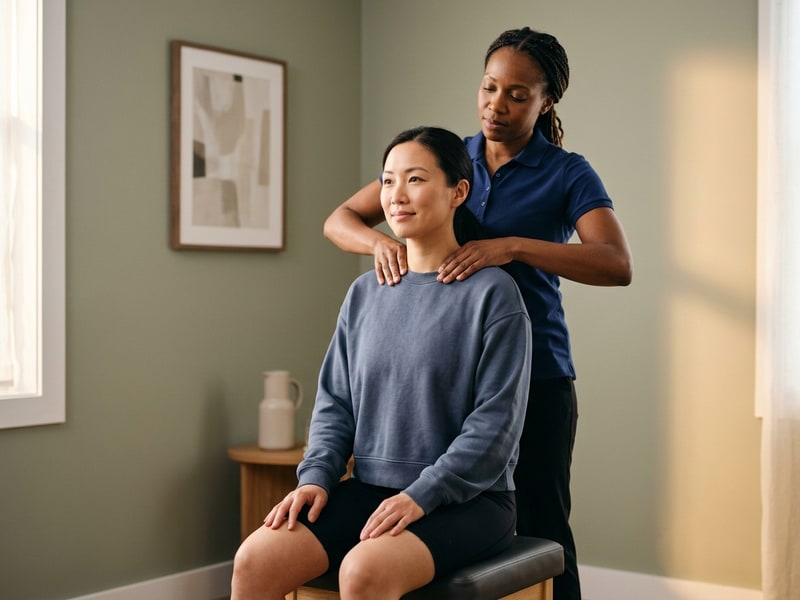
6 common questions about releasing lower back at Valley Chiropractic.
If your lower back feels locked up after a long shift, a drive home on I-205, or a weekend of yard work, you are not alone. Lower back pain is one of the most common reasons people walk into our Tracy office, and most patients want the same thing: a safe way to release that tight, stuck feeling without making it worse.
This page answers the questions we hear most often about releasing the lower back at home, what actually helps, what to skip, and when a tight back is really a sign of something that needs an exam. Our medical reviewer is Dr. Johannes Garrido, D.C., and the guidance below reflects how we treat lower back pain across our Tracy, Mountain House, Manteca, and Ripon clinics.
What is the safest way to release a tight lower back at home?
The safest way to release a tight lower back at home is gentle movement, not aggressive stretching or self-cracking. Start with easy, pain-free motion like slow knee-to-chest pulls, pelvic tilts on your back, and the cat-cow stretch on your hands and knees. Hold each position for 20 to 30 seconds and repeat two or three times. If something sharpens the pain or sends it down your leg, stop and back off.
Walking is one of the most underrated releases for the lower back. A 10 to 15 minute walk around your Tracy neighborhood, whether that is a loop through Gretchen Talley Park or around the block after dinner, gently pumps blood through the muscles and lubricates the joints. Low back pain is a leading cause of disability worldwide, and global guidelines now put movement and self-management at the center of care rather than bed rest ([Lancet, 2018](https://pubmed.ncbi.nlm.nih.gov/29573870/)).
Heat for 15 to 20 minutes before you stretch can help the tissue relax. Ice is better after a flare-up or if the area feels swollen and hot. Avoid long stretches of sitting on the couch, which tends to lock the hips back up within an hour.
What we tell patients to skip: twisting the spine hard to force a pop, hanging off a stair step, or asking a family member to walk on your back. Those moves can irritate a disc or facet joint that was already inflamed. If gentle movement, heat, and walking are not easing things within a few days, that is a good time to get checked at our [Tracy office](/locations/tracy) or learn more about [chiropractic care](/services/chiropractic-care) for the lower back.
Why does my lower back feel like it needs to crack or pop?
That feeling usually comes from stiffness in the small joints of the spine, called facet joints, or from tight muscles pulling across the pelvis. When a joint has not moved through its full range for a while, the surrounding tissue sends a signal that feels like pressure or a need to pop. A gentle release of movement often relieves that signal, even without an audible crack.
For people in Tracy who commute to the Bay Area or sit through long days at a desk in Mountain House tech jobs, the lower back joints get stuck in one position for hours. Blood flow drops, the hip flexors shorten, and the lumbar spine stiffens. By the time you stand up, your back is begging for motion. That is the "needs to crack" feeling.
Self-cracking by twisting hard can work for a moment, but it often moves the joints that are already loose and skips the ones that are actually stuck. Over time this can create a cycle of twisting more often with less relief. A chiropractor is trained to find the specific segment that is restricted and move only that one, which is why an adjustment usually gives longer relief than self-cracking.
If you are feeling this constantly, two things help. First, interrupt sitting every 30 to 45 minutes with a quick stand, walk, or hip stretch. Second, get the restricted joints assessed. We use a few different hands-on approaches depending on the patient, which you can read about on our [chiropractic techniques](/services/chiropractic-techniques) page. If the pain is sharp, burning, or shooting into the leg rather than just stiff, that is less about a joint needing to pop and more about possible nerve involvement, which we cover in a later question.
What stretches actually help release the lower back?
The stretches that help most target the hips and the middle back, not just the lower back itself. The lumbar spine often tightens because the joints above and below it are not moving well. Loosen those, and the lower back usually calms down on its own.
Four stretches we give patients at our Tracy clinic:
1. **Knee to chest**: Lie on your back and pull one knee gently toward your chest for 30 seconds. Switch sides. This decompresses the lower lumbar joints.
2. **Figure-four piriformis stretch**: Lying on your back, cross one ankle over the opposite knee and pull the bottom thigh toward you. This releases the deep hip rotators that pull on the sacrum.
3. **Hip flexor lunge**: In a half-kneeling position, tuck your pelvis under and lean forward. Hold 30 seconds per side. Tight hip flexors from long drives on I-205 or desk work are a top driver of lower back tightness.
4. **Cat-cow**: On hands and knees, slowly arch and round the spine for 10 slow reps. This mobilizes every segment of the lumbar and thoracic spine.
Structured exercise and stretching programs show meaningful benefit for chronic low back pain compared to usual care, according to a Cochrane review of exercise therapy ([Cochrane, 2021](https://pubmed.ncbi.nlm.nih.gov/34580864/)). A separate systematic review commissioned by the World Health Organization also found that structured exercise programs reduce pain and improve function in adults with chronic low back pain, though the quality of evidence varied by exercise type ([Journal of Occupational Rehabilitation, 2023](https://pubmed.ncbi.nlm.nih.gov/37991647/)).
Do these stretches once or twice a day, not just when the pain hits. Consistency matters more than intensity. If one of them sharply increases pain or triggers leg symptoms, drop it and have the back assessed. You can learn more about our approach on the [lower back pain](/pain/lower-back) page.
When is a tight lower back actually something more serious?
A tight lower back is usually mechanical and improves with movement, heat, and time. It becomes a bigger concern when certain red flags show up. Call our office or seek urgent care if your lower back pain comes with any of the following: numbness in the groin or inner thighs, loss of bladder or bowel control, progressive weakness in a leg, unexplained weight loss, fever, or pain that is severe and constant even at rest.
Shooting pain down the back of one leg below the knee, often called sciatica, suggests a nerve is being irritated rather than a muscle being tight. A systematic review found that lumbar disc herniation with radiculopathy has a measurable incidence in working-age adults and is linked to risk factors like heavy lifting, prolonged sitting, and smoking ([European Spine Journal, 2025](https://pubmed.ncbi.nlm.nih.gov/39453541/)). That matches what we see in Tracy and Mountain House patients who commute long hours or work physical jobs around the Central Valley.
Older adults with lower back pain that worsens with standing or walking and eases when leaning forward on a cart may be dealing with lumbar spinal stenosis, a narrowing of the spinal canal that needs proper imaging and diagnosis ([American Family Physician, 2024](https://pubmed.ncbi.nlm.nih.gov/38648834/)).
For most people, none of these red flags apply, and the tight back responds to conservative care. But we would rather see you and rule things out than have you guess. On a first visit we take a history, do a physical exam, test the nerves, and screen for anything that needs imaging or a referral. If surgery is ever on the table, that decision belongs with you and a spine specialist, not with a chiropractor alone. Our role is to handle the conservative care side and know when to send you elsewhere. You can read what a first visit looks like on our [chiropractic care](/services/chiropractic-care) page or in our [pinched nerve FAQ](/faq/what-are-the-symptoms-of-a-pinched-nerve-in-the-lower-back).
Can massage help release the lower back, or do I need an adjustment?
Both can help, and they often work best together. Massage targets the muscles and fascia, which is useful when the tightness is driven by overworked tissue. Adjustments target the joints, which is useful when a specific segment is restricted and not moving well. Deciding which to try first depends on what is driving your pain.
If your lower back feels like a knotted, aching band of muscle after heavy yard work, lifting, or a tough workout, massage is a reasonable starting point. A Cochrane review found that massage can provide short-term improvements in pain and function for low-back pain, though the long-term benefits are less certain and more research is needed ([Cochrane, 2015](https://pubmed.ncbi.nlm.nih.gov/26329399/)).
If your back feels stuck, catches when you move a certain way, or has that "needs to pop" sensation, a chiropractic adjustment is usually the better first move. The adjustment restores motion to the specific joint that is restricted, and the surrounding muscles often relax on their own once the joint moves freely again.
In our Tracy and Manteca offices, we frequently combine the two. A patient might get soft tissue work to calm the muscles down, then an adjustment to restore joint motion, then specific stretches to take home. That layered approach tends to give longer relief than either one alone. We also offer [massage therapy](/services/massage-therapy) as a standalone service for patients who want to manage stress and muscle tension between adjustments.
If you are not sure which to start with, we can help you decide at an initial exam. Our [chiropractor vs massage therapy FAQ](/faq/chiropractor-vs-massage-therapy-which-should-i-try-first) breaks down the differences in more detail. Either way, pairing hands-on care with daily movement is what gives the most lasting release.
How can Tracy commuters prevent the lower back from tightening up again?
The lower back tightens when it sits in one position for too long, so prevention for Tracy commuters comes down to breaking up that stillness and strengthening the muscles that support the spine. Whether you drive the Altamont to the Bay Area, head up I-5 to Stockton, or sit at a desk in Mountain House, the pattern is the same: hips lock, glutes shut off, lower back takes the load.
A few habits that help:
- **Adjust your car seat**. Hips slightly higher than knees, lumbar support filling the small of your back, seatback close to upright. A rolled towel works if your car lacks lumbar support.
- **Micro-breaks on long drives**. On the way home from the Bay, stop once if traffic allows, stand up, and do 10 standing hip extensions. Even 60 seconds helps.
- **Stand every 30 to 45 minutes at work**. Set a timer. Walk to the water cooler, do a quick hip flexor stretch, then sit back down.
- **Strengthen the core and glutes**. Bridges, bird dogs, and dead bugs done 3 times a week make a measurable difference. Structured exercise reduces pain and disability for people with chronic low back pain ([Journal of Occupational Rehabilitation, 2023](https://pubmed.ncbi.nlm.nih.gov/37991647/)).
- **Sleep position matters**. Side sleepers do best with a pillow between the knees. Back sleepers do best with a pillow under the knees.
If your back has flared more than once in the last year, that is a signal to get ahead of it with [preventative care](/services/preventative-care) rather than waiting for the next lockup. We also wrote a longer piece on [lower back pain for Mountain House commuters](/blog/lower-back-pain-mountain-house-commuters) that applies to anyone driving long stretches in the Central Valley. Consistency with small daily habits beats any single stretch or treatment.