7 common questions about chiropractor vs massage at Valley Chiropractic.
Patients in Tracy ask us this question almost every week: should I see a chiropractor or a massage therapist first? Both can ease pain and tension, but they work on different tissues and solve different problems. A chiropractor focuses on joint motion and nerve function. A massage therapist focuses on muscles and soft tissue.
The right starting point depends on what is causing your symptoms. Sharp, shooting, or nerve-related pain usually points toward chiropractic care first. Tight, achy, overworked muscles often respond best to massage. Many of our patients end up using both, in the right order, for faster and longer-lasting relief. Below, Dr. Dalvir Atwal answers the most common questions we hear from patients across Tracy, Mountain House, Manteca, and Ripon.
Chiropractor vs massage therapist: what is the actual difference?
A chiropractor adjusts joints to restore motion and reduce nerve irritation. A massage therapist works on muscles and connective tissue to release tension and improve circulation. Both can help you feel better, but they treat different layers of the body.
Chiropractors are licensed doctors who diagnose musculoskeletal conditions, take X-rays when needed, and perform spinal adjustments. According to the American Chiropractic Association, chiropractic care focuses on the relationship between the spine, nervous system, and overall function. When a joint is stuck or misaligned, the surrounding muscles often tighten to protect it. Adjusting the joint can release that muscle guarding at the source.
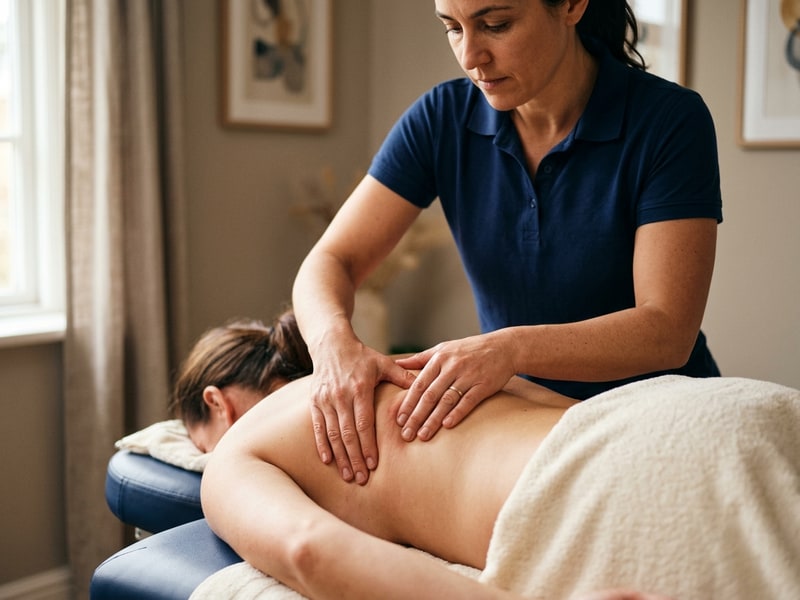
Massage therapists are licensed bodyworkers who use hands-on techniques like Swedish, deep tissue, trigger point, and myofascial release. They cannot adjust joints, order imaging, or diagnose conditions. What they can do, very well, is reduce muscle tightness, break up adhesions, and calm the nervous system.
Here is a simple way to think about it. If your pain is sharp, shooting, tingling, or radiates down an arm or leg, you likely have a joint or nerve problem. That is chiropractic territory. If your pain is dull, achy, and feels like a knot you want to dig into, that is muscle tension, and massage is a great fit.
Many Tracy patients who commute over the Altamont Pass come in with both problems at once: stuck mid-back joints from sitting in traffic plus rock-hard trapezius muscles from gripping the wheel. In those cases, we combine [chiropractic care](/services/chiropractic-care) with [massage therapy](/services/massage-therapy) in the same visit. The adjustment frees the joint, and the massage helps the muscles let go so the correction holds longer.
Should I get a massage or chiropractor first for back pain?
For most back pain, see a chiropractor first. A chiropractor can examine you, identify whether the issue is joint, disc, nerve, or muscle-related, and then build the right plan. Going straight to massage without a diagnosis can sometimes irritate a disc problem or pinched nerve.
The [National Center for Complementary and Integrative Health](https://www.nccih.nih.gov/health/spinal-manipulation-what-you-need-to-know) reports that spinal manipulation can help with acute and chronic low back pain, often with results comparable to other first-line treatments. That is why national guidelines, including those from the American College of Physicians, recommend trying non-drug approaches like spinal manipulation before pain medication.
Here is how we usually sequence care at our [Tracy office](/locations/tracy):
1. **Exam and diagnosis.** We check joint motion, muscle tone, reflexes, and nerve function. If needed, we image the area.
2. **Adjustment first.** If a joint is restricted, we adjust it. This often reduces muscle spasm immediately because the nervous system stops sending protective signals.
3. **Massage second.** Once the joint moves freely, massage can target the tight muscles without fighting against a locked joint.
If you start with massage and the underlying joint is still stuck, the muscles tend to tighten right back up within a day or two. That is the most common reason patients tell us massage "feels great but never lasts."
There are exceptions. If you just overdid it in the yard, slept wrong, or had a hard workout, and the pain is purely muscular with no shooting or numbness, massage first is reasonable. For anything involving nerve symptoms, see our [sciatica](/services/sciatica) or [pinched nerve](/services/pinched-nerves) pages, and start with a chiropractic exam.
Do I need both massage and chiropractor, or just one?
Many patients do best with both, but not everyone needs both. It depends on how long you have had the problem, how much muscle tension is involved, and how your body responds to care.
A single approach is often enough when:
- The problem is brand new (less than a week) and purely joint-related
- You have one specific tight muscle from a workout
- You are doing maintenance or [preventative care](/services/preventative-care)
Both therapies usually work better together when:
- Pain has been there for more than a few weeks
- You sit at a desk or commute long hours
- You have a job with repetitive motion
- You are recovering from an [auto accident](/services/auto-accident-injury) or [whiplash](/services/whiplash-treatment)
- You feel both joint stiffness and deep muscle knots
Research published in the journal [Spine](https://pubmed.ncbi.nlm.nih.gov/19119539/) found that combining manual therapies often produces better outcomes for chronic low back pain than a single approach alone. That matches what we see clinically. The adjustment restores motion, the massage releases the muscles that were compensating, and the body holds the correction longer.
A typical plan at our office might look like this: chiropractic visits twice a week for two weeks, with massage added once a week. As you improve, we space everything out. Within a month or two, most patients move to a monthly maintenance schedule with one combined session.
If cost is a concern, start with chiropractic since it includes the diagnosis and can guide the rest of your care. Check our [insurance FAQ](/faq/insurance) for coverage details. Many Tracy-area plans cover chiropractic, and we offer affordable massage add-ons for patients already in active care.
Massage vs adjustment: which gives faster relief?
Adjustments usually give faster relief for joint and nerve pain. Massage usually gives faster relief for muscle soreness and tension. The speed depends entirely on what is causing your pain in the first place.
When a joint is restricted, an adjustment can restore motion in seconds. Patients often stand up off the table and say their neck or back feels lighter immediately. That happens because the adjustment stimulates joint mechanoreceptors, which signal the nervous system to relax the surrounding muscles. The [American Chiropractic Association](https://www.acatoday.org/) notes that this neurological response is one reason manipulation produces such quick changes in pain and range of motion.
Massage works through a different pathway. It increases blood flow, breaks up adhesions in the fascia, and calms an overactive nervous system. The effect is real but tends to build over the session rather than happen in one moment. After a good 60-minute deep tissue massage, you should feel looser, warmer, and less guarded. The next day, you may feel even better as inflammation settles.
Duration of relief also differs. An adjustment can hold for days or weeks if the muscles around the joint cooperate. Massage relief often lasts a few days to a week before tension creeps back, especially if the underlying joint problem was not addressed.
In practice, we use both tools depending on the goal:
- **Acute lock-up** ("I can't turn my head"): adjustment first, then light massage
- **Chronic muscle tension** ("my shoulders are always tight"): massage with adjustments to address the underlying cause
- **Headaches from neck tension**: combination works best, as covered on our [headache and migraine relief](/services/headache-migraine-relief) page
- **Post-workout soreness**: massage alone is usually enough
If you are not sure which you need, book a chiropractic exam first. We will tell you honestly which approach, or combination, will get you better fastest.
Deep tissue vs chiropractic: which is better for chronic tightness?
For chronic tightness, you typically need both, but chiropractic should come first to address why the muscles keep tightening. Deep tissue massage feels amazing on a knotted muscle, but if a joint underneath is not moving correctly, the knot will return.
Chronic tight muscles are almost always a symptom, not the root problem. The most common drivers we see in Tracy patients include:
- Restricted spinal joints from prolonged sitting
- Old injuries that healed with altered movement patterns
- Poor posture from desk work or commuting
- Disc issues that cause protective muscle guarding
- Nerve irritation creating reflexive tension
Deep tissue massage uses slow, firm pressure to reach deeper layers of muscle and fascia. It is excellent for releasing chronic knots, scar tissue, and adhesions. However, a 2017 review in the [Journal of Bodywork and Movement Therapies](https://pubmed.ncbi.nlm.nih.gov/29037612/) found that massage alone produced shorter-lasting benefits for chronic neck and back pain compared to combined manual therapy approaches that included joint mobilization.
Chiropractic adjustments work upstream. By restoring joint motion and reducing nerve irritation, they remove the reason the muscle is staying tight. Once the source is addressed, the muscle has permission to relax, and massage can finish the job.
A realistic plan for chronic tightness in the [upper back](/pain/upper-back) or [neck](/blog/neck-pain-in-tracy-ca) might look like:
- Weeks 1-2: Two adjustments per week, one deep tissue massage per week
- Weeks 3-4: One adjustment per week, one massage every other week
- Maintenance: One combined visit per month
If you have tried massage for months without lasting results, that is your sign to add chiropractic. And if you have been adjusted regularly but still feel knotted, add massage. The two therapies are partners, not competitors. Most of our Mountain House and Tracy commuters use both to stay ahead of the daily strain of Bay Area traffic.
Are there times I should not get a massage or adjustment?
Yes. Both therapies are very safe for most people, but there are specific situations where you should hold off or get cleared first. A proper exam helps us catch these before treatment.
**Hold off on massage if you have:**
- A fresh injury with significant swelling or bruising (wait 48 to 72 hours)
- A blood clot or history of deep vein thrombosis
- Active skin infection in the treatment area
- Recent surgery without surgeon clearance
- A fever or active illness
**Hold off on adjustments (or get a specialized approach) if you have:**
- Severe osteoporosis
- Certain types of inflammatory arthritis in the neck
- Recent fracture in the area
- Some vascular conditions
- Cancer involving the bones of the spine
None of these mean you can never receive care. They mean we use different techniques, lighter forces, or refer out for imaging first. The [National Center for Complementary and Integrative Health](https://www.nccih.nih.gov/health/chiropractic-in-depth) notes that serious complications from chiropractic care are rare when treatment is provided by a licensed professional after a proper exam.
For pregnancy, both therapies can be excellent with the right training. We offer dedicated [prenatal chiropractic](/services/prenatal-chiropractic) and [prenatal massage](/services/prenatal-massage) using specialized tables and techniques. Children also do well with both, in age-appropriate forms. See our [pediatric chiropractic FAQ](/faq/is-chiropractic-care-safe-and-effective-for-kids) for details.
If you have been in a car accident, even a minor one, get checked before booking a massage. Soft tissue injuries can be aggravated by deep work in the first few days. Our [whiplash recovery timeline](/blog/whiplash-recovery-timeline-what-to-expect-in-weeks-1-through-12) blog explains the right sequence of care.
When in doubt, call our Tracy office. We will ask the right questions, review your history, and tell you whether to start with chiropractic, massage, both, or get cleared by another provider first. There is no charge for that conversation.
How do I choose between a chiropractor and massage therapist in Tracy?
Start by matching the provider to the symptom. Sharp, shooting, radiating, or nerve-like pain points to a chiropractor. Dull, achy, muscle-only tightness points to a massage therapist. If you are not sure, a chiropractic exam costs about the same as a massage and includes a diagnosis you can act on.
Here is a quick decision guide for Tracy patients:
**See a chiropractor first if you have:**
- Back or neck pain that limits your motion
- Headaches or migraines
- Numbness, tingling, or shooting pain into an arm or leg
- Pain after a car accident or fall
- Sciatica or [pinched nerve](/services/pinched-nerves) symptoms
- Recurring issues that massage has not fixed
- Posture or alignment concerns
**See a massage therapist first if you have:**
- General stress and tension
- One specific sore muscle from exercise
- Mild stiffness without sharp pain
- A desire to relax and recover
- Already been examined and cleared by a chiropractor or doctor
At Valley Chiropractic, you do not have to choose between two separate offices. We have licensed chiropractors and licensed massage therapists under one roof in [Tracy](/locations/tracy), [Mountain House](/locations/mountain-house), [Manteca](/locations/manteca), and [Ripon](/locations/ripon). That means your exam, adjustment, and massage can happen in the same visit, with everyone on the team looking at the same plan.
Many of our Tracy patients work long hours in the Bay Area, drop kids off in Mountain House, or run businesses in Manteca. They do not have time to coordinate two separate providers. A combined visit cuts down on appointments and tends to produce faster results because the therapies build on each other.
If you want a recommendation specific to your situation, book a consultation with [Dr. Atwal](/doctors/dr-atwal) or any of our doctors. We will examine you, explain what we find in plain language, and tell you honestly whether you need chiropractic, massage, both, or a referral elsewhere. Curious what a first visit looks like? See our [first visit FAQ](/faq/first-visit).