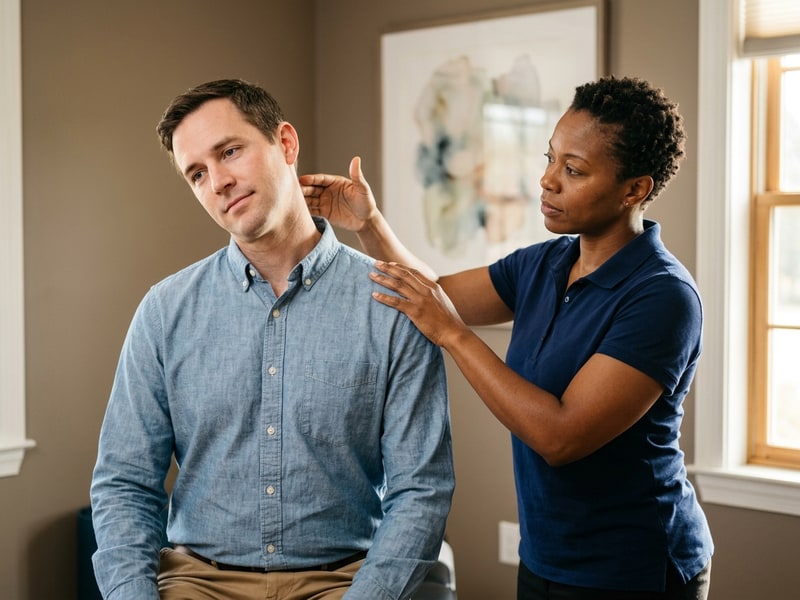
6 common questions about neck adjustment signs at Valley Chiropractic.
Neck pain is one of the most common reasons patients walk into our Manteca office, and most of the time people wait too long before asking for help. If your neck feels stiff after a workday, pops when you turn your head, or sends a dull ache into your shoulder, your spine is trying to tell you something.
This page covers the practical signs that your neck may benefit from a chiropractic evaluation, the symptoms that mean you should skip the clinic and head to an ER instead, and what a first visit at Valley Chiropractic actually looks like. Dr. Johannes Garrido and the team see neck pain every day across our Manteca, Mountain House, Tracy, and Ripon offices, and the answers below reflect what we tell patients in the exam room.
What are the most common signs my neck needs a chiropractic adjustment?
The most common signs are stiffness when turning your head, a dull ache at the base of your skull, tight muscles across the top of your shoulders, and clicking or popping when you move your neck. If you also notice headaches that start in the back of your head, trouble checking your blind spot while driving, or soreness that gets worse by the end of the workday, your cervical spine is likely not moving the way it should.
Neck pain is extremely common. Clinical reviews describe it as a leading source of disability in adults, often linked to posture, prolonged sitting, and minor trauma like fender benders ([Neck pain, Medical Clinics of North America, 2009](https://pubmed.ncbi.nlm.nih.gov/19272509/)). In our Manteca office we see this constantly in commuters driving the 205 and 580 into the Bay Area, parents hunched over laptops at home, and warehouse workers lifting all day in the Spreckels Park corridor.
A few patterns we watch for during the exam:
- **Range of motion loss.** If you cannot comfortably look over your shoulder or tilt your ear toward your shoulder, a joint in your neck is likely restricted.
- **One-sided symptoms.** Pain, tightness, or headaches that only show up on one side often point to a specific segment that needs attention.
- **Referred symptoms.** Tingling into the shoulder blade, upper arm, or hand can mean a nerve is being irritated. Learn more on our [pinched nerve page](/services/pinched-nerves).
- **Morning stiffness that eases with movement.** Classic sign of a joint that is stuck rather than injured tissue.
If two or more of these match your experience, a chiropractic evaluation is reasonable. We will test your motion, check the joints individually, and only recommend an adjustment if the exam supports it. You can read more about what we offer on our [chiropractic care page](/services/chiropractic-care).
How is a neck that needs adjustment different from one that just needs rest?
A neck that needs rest usually feels sore after a specific event (a hard workout, sleeping funny, a long drive) and improves steadily over two to three days with heat, gentle movement, and over-the-counter pain relief. A neck that needs an adjustment tends to feel stuck, keeps coming back to the same stiff spot, and does not fully resolve even when the sharp pain fades.
Here is how we help patients tell the difference at our Manteca clinic:
**Signs it is probably just tired tissue:**
- Pain started after one clear event and is already improving.
- You can move your head through full range, even if it is tender.
- No headaches, no arm symptoms, no dizziness.
- Heat and light stretching make a noticeable difference within 48 hours.
**Signs the joint itself is involved:**
- The same spot has been stiff for weeks or months.
- Range of motion is limited in one or more directions.
- Pain shows up predictably with certain positions, like reading in bed or driving.
- Massage feels good temporarily but the stiffness returns within a day or two.
The research backs up a combined approach for mechanical neck pain. A Cochrane review of exercise programs for neck disorders found that targeted strengthening and endurance work for the neck and shoulder girdle reduce pain and improve function ([Exercises for mechanical neck disorders, Cochrane, 2015](https://pubmed.ncbi.nlm.nih.gov/25629215/)). A more recent Cochrane review looked specifically at manual therapy paired with exercise and found this combination helpful for neck pain ([Manual therapy with exercise for neck pain, Cochrane, 2025](https://pubmed.ncbi.nlm.nih.gov/41363159/)).
That is why our treatment plans usually pair adjustments with simple home exercises rather than relying on either alone. If you want to try conservative self-care first, give it a week. If you are no better, or if symptoms are spreading, book an evaluation.
Can neck tension cause headaches, and does adjusting the neck help?
Yes. Tension in the small joints and muscles of the upper neck is a well known trigger for headaches that start at the base of the skull and wrap over the top of the head or behind the eyes. These are called cervicogenic headaches, and they often respond well to care that targets the neck rather than the head itself.
Patients usually describe a dull, steady ache rather than the throbbing of a migraine. It often shows up after a long day at a screen, worsens when they tilt their head back, and eases when they lie down. If you also feel a knot at the base of your skull on one side, or your headaches follow a stiff morning neck, your cervical spine is a reasonable suspect.
Clinical practice guidelines for neck-pain-associated disorders list manual therapy, exercise, and patient education as recommended options for both recent and ongoing neck pain and related headaches ([Treatment of Neck Pain-Associated Disorders, JMPT, 2016](https://pubmed.ncbi.nlm.nih.gov/27836071/)). Researchers have also mapped out the nerve pathways that help explain why adjusting the cervical spine can change pain signaling in the surrounding muscles and joints ([Neurophysiological mechanisms of chiropractic spinal manipulation, European Journal of Pain, 2021](https://pubmed.ncbi.nlm.nih.gov/33786932/)).
In our Manteca office we see cervicogenic headaches most often in:
- Remote workers using laptops without an external monitor.
- Parents carrying infants and toddlers on one hip.
- Students at Sierra High and local community college hunched over phones and books.
- Commuters doing long round trips to the Bay Area.
We will check your neck motion, feel for restricted joints in the upper cervical area, and look at your posture and shoulder mechanics. For a deeper look at headache types and when to seek care, see our [headache and migraine relief page](/services/headache-migraine-relief) or our FAQ on [headache or migraine](/blog/headache-or-migraine-when-to-see-chiropractor).
When should I NOT get my neck adjusted and go to the ER instead?
Skip the chiropractor and go to an emergency room or urgent care if your neck pain comes with any of these red flags: severe pain after a car crash or fall, numbness or weakness in both arms or legs, loss of bladder or bowel control, trouble speaking or swallowing, a sudden severe headache unlike any you have had before, fever with a stiff neck, or dizziness paired with vision changes or facial drooping.
These symptoms can point to a fracture, spinal cord injury, stroke, infection, or other emergency that needs imaging and medical care first. A chiropractic adjustment is not the right starting point.
Other situations where you should be evaluated by a medical doctor before any adjustment:
- Recent neck surgery or hardware in your cervical spine.
- Known severe osteoporosis.
- Active cancer with possible spread to bone.
- A connective tissue disorder like hypermobile Ehlers-Danlos syndrome, which can affect joint stability and requires a modified approach ([Hypermobile Ehlers-Danlos Syndrome, GeneReviews](https://pubmed.ncbi.nlm.nih.gov/20301456/)).
- Suspected rheumatoid arthritis affecting the upper neck.
If you were in a car accident, even a minor one, we still want to see you, but the timing and type of care matter. Read our guide on the [first 72 hours after an auto accident](/blog/auto-accident-chiropractor-manteca-first-72-hours) and our [whiplash treatment page](/services/whiplash-treatment) for what to expect.
For cases that fall between "obvious emergency" and "routine stiffness," our team is happy to triage over the phone. If you call our Manteca office and describe symptoms that worry us, we will tell you honestly to go to the ER or your primary care doctor first. We also keep a longer list of warning signs on our [chiropractic emergencies FAQ](/faq/chiropractic-emergencies-when-to-seek-urgent-care-or-the-er-instead). Surgical evaluation is sometimes needed for progressive neurologic loss, and that decision belongs with you and a spine specialist, not a chiropractor alone.
How long should I try stretching or heat before seeing a chiropractor for neck pain in Manteca?
A reasonable rule of thumb is one week. If your neck pain is mild, started recently, and has no red flag symptoms, try heat, gentle range-of-motion movements, better pillow support, and screen-time breaks for about seven days. If you are not clearly improving by then, or if the pain is interfering with sleep, driving, or work, it is time to get evaluated.
We tell Manteca patients to call sooner, not later, when:
- Pain is sharp enough to limit turning your head while driving on Highway 99 or 120.
- Symptoms are spreading from the neck into the shoulder, arm, or hand.
- You are reaching for over-the-counter pain medication every day.
- Headaches are becoming part of the pattern.
- Sleep is being disrupted more than two or three nights in a row.
Exercise and movement are genuinely important for recovery. Cochrane reviews support targeted exercise as a core part of care for both neck disorders and chronic low back pain ([Exercises for mechanical neck disorders, 2015](https://pubmed.ncbi.nlm.nih.gov/25629215/); [Exercise therapy for chronic low back pain, 2021](https://pubmed.ncbi.nlm.nih.gov/34580864/)). The goal of chiropractic care is not to replace that work. It is to restore joint motion so that the exercises you do at home actually hold.
In practice, patients who come in during week one or two of a flare up usually need fewer visits than patients who tough it out for three months. Early care tends to mean faster recovery and less chance of the problem settling into a chronic pattern.
If you are not sure whether your situation calls for an appointment, our front desk team at the [Manteca office](/locations/manteca) can walk you through it. You can also read [what happens at a first chiropractic visit](/blog/what-happens-first-chiropractic-visit) so you know exactly what to expect before you book.
What does a neck adjustment actually feel like, and is it safe?
A neck adjustment at Valley Chiropractic is a quick, controlled movement applied to a specific joint in your cervical spine. Most patients feel a brief pressure, sometimes a small pop (which is just gas releasing from the joint, similar to cracking a knuckle), and then a noticeable sense of relief or lightness. It is not a yank, a twist for show, or a surprise move. We tell you what we are doing before we do it.
For patients who are nervous about traditional adjustments, we have gentler options. These include instrument-assisted techniques using an Activator tool, drop-table adjustments, and low-force mobilization. Our [chiropractic techniques page](/services/chiropractic-techniques) explains the main approaches, and you can also read our plain-English guide to [Diversified, Activator, and Gonstead methods](/blog/chiropractic-techniques-explained-diversified-activator-and-gonstead-in-plain-en).
On safety: a published critical review of the field notes that chiropractic care is widely used and that serious adverse events from neck manipulation are uncommon, while mild soreness for a day or two after a session is more typical ([Chiropractic: a critical evaluation, Journal of Pain and Symptom Management, 2008](https://pubmed.ncbi.nlm.nih.gov/18280103/)). Our clinical practice guideline for neck disorders also supports manual therapy and exercise as reasonable options for most mechanical neck pain ([Treatment of Neck Pain-Associated Disorders, JMPT, 2016](https://pubmed.ncbi.nlm.nih.gov/27836071/)).
What we do before any adjustment:
- A full history, including blood pressure, medications, and prior injuries.
- Range-of-motion and neurologic testing.
- Palpation of each cervical segment to find the restricted joints.
- A discussion of options, including non-manipulative care if you prefer.
If anything about your exam suggests an adjustment is not the right call, we will say so and recommend a different path, whether that is massage therapy, imaging, or a referral. You can meet [Dr. Garrido](/doctors/dr-garrido) and the rest of our team on our provider pages before you book.