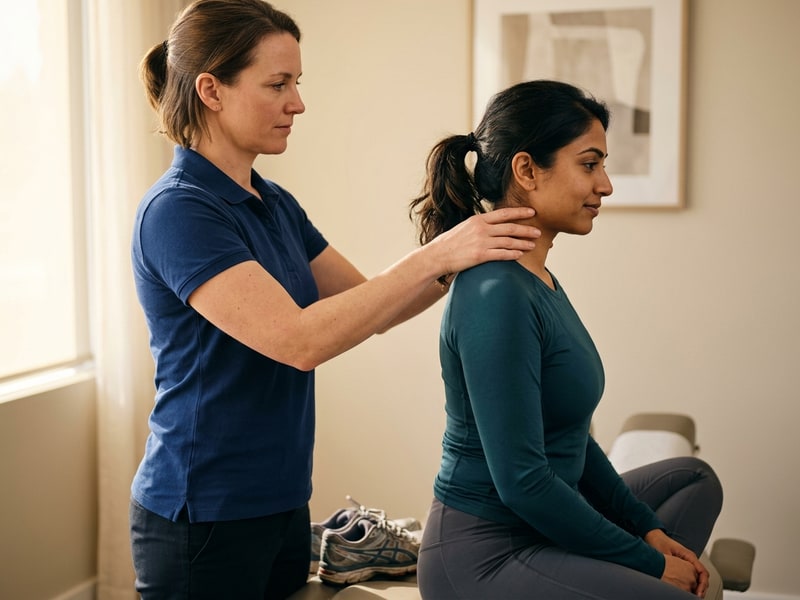
6 common questions about sports injuries at Valley Chiropractic.
Central Valley athletes stay busy year-round. Between weekend soccer at Legacy Fields, cycling the Delta backroads, high school football at Tracy High, and Spartan-style training at local gyms, sports injuries are common. Knowing what to do in the first 24 to 72 hours can make a real difference in how fast you get back to play.
This FAQ answers the sports injury questions Tracy patients ask us most: when ice actually helps, when rest is enough, when you need a chiropractor, and when you should head straight to urgent care. Dr. Joseph Russell and the team at Valley Chiropractic put this together to give you clear, plainspoken guidance you can use before your next practice or game.
For a fresh injury in the first 24 to 48 hours, ice is usually the better choice. Ice helps calm swelling and dulls sharp pain after an acute strain, sprain, or contact injury. Apply a cold pack wrapped in a thin towel for about 15 to 20 minutes at a time, with at least 40 minutes between sessions, and never place ice directly on bare skin.
Heat is better once the acute swelling has settled, usually after the first 2 to 3 days. Heat relaxes tight muscles and boosts blood flow, which can help with stiffness from an older injury or a muscle spasm that is not swollen. A warm shower before stretching, or a heating pad on a tight lower back, can loosen things up before activity.
A good rule for Tracy athletes: if it looks puffy, bruised, or feels hot, use ice. If it feels stiff and achy but is not swollen, try heat. Some athletes alternate the two after the first few days, which can feel good but is not strictly necessary.
Research on ice for soft tissue injury is actually mixed. The traditional RICE approach (Rest, Ice, Compression, Elevation) has shifted in recent years, with sports medicine groups now emphasizing gentle movement and loading sooner rather than long rest. The [National Center for Complementary and Integrative Health](https://www.nccih.nih.gov/health/chiropractic-in-depth) reports that 11 percent of U.S. adults used chiropractic care in 2022, and most of them used it for pain management.
What ice will not do is fix a structural problem. If pain, swelling, or limited motion sticks around past 3 to 5 days, or if you cannot bear weight, it is time to get evaluated. Our [sports injury care](/services/sports-injury) team can look at the joint, check the surrounding muscles, and tell you whether it is safe to keep training or whether you need imaging first.
How do I know if I should rest or push through a sports injury?
The short answer: sharp pain, swelling, or loss of function means rest. Dull soreness that improves as you warm up usually means you can keep moving, carefully. Pushing through the wrong kind of pain is how minor injuries become chronic ones.
Here is a simple framework we use with Tracy patients. Green light pain is mild, symmetrical, and fades within a day. That is normal training soreness. Yellow light pain is sharper, sticks around more than 48 hours, or changes how you move (limping, favoring one shoulder, guarding your neck). Yellow light means back off intensity, cross-train, and get it checked if it does not improve in a week. Red light pain includes swelling you can see, joint instability, numbness or tingling, inability to bear weight, or pain that wakes you up at night. Red light means stop and get evaluated.
The [American Chiropractic Association](https://www.acatoday.org/) points out that early conservative care for musculoskeletal complaints often leads to better outcomes than waiting. Delaying care and trying to train through a real injury can lead to compensations elsewhere in the body. A Tracy runner who ignores a mild calf strain often ends up with hip or lower back pain a few weeks later because of an altered gait.
Rest does not have to mean total shutdown. If your ankle is hurt, you can often still do upper body work. If your shoulder is bothering you, lower body training is usually fine. This is called relative rest and it keeps you fit while the injured area calms down.
If you are not sure which color your pain is, err on the side of caution. Our team at the [Tracy office](/locations/tracy) can usually get you in quickly to sort it out, so you are not guessing during your training week.
When should I see a chiropractor after a sports injury instead of just resting?
See a chiropractor when pain lasts more than 3 to 5 days, when a joint feels stuck or off, when the same injury keeps coming back, or when the injury is affecting how you move in daily life. Rest alone often does not fix underlying joint restrictions or muscle imbalances that caused the injury in the first place.
Chiropractors are trained to evaluate the whole kinetic chain. A knee problem in a Tracy soccer player might trace back to hip mobility. A recurring shoulder issue in a swimmer might involve the mid-back and neck. This is one common condition athletes deal with, but results vary by person and injury type.
What a chiropractor will not do is replace an orthopedic evaluation for a suspected fracture, complete ligament tear, or dislocation. If we suspect one of those, we refer out for imaging and a specialist opinion. For most soft tissue and joint-related sports complaints, though, conservative care is a reasonable first step. Learn more about our approach on the [sports injury service page](/services/sports-injury) or check out [extremity care](/services/extremity-care) for issues in the shoulders, elbows, wrists, hips, knees, or ankles.
What are the most common sports injuries you see in Tracy athletes?
The most common sports injuries we treat at our Tracy office fall into a few big categories: lower back strains, ankle sprains, shoulder issues, knee pain, and neck strains. The specific mix depends on the season and the sport.
In the fall, high school football and soccer bring in a lot of ankle sprains, shoulder stingers, and neck strains. We wrote more about this in our post on [high school sports injuries and back-to-school readiness](/blog/high-school-sports-injuries-back-to-school-chiropractic-readiness). Spring and summer bring baseball and softball players with elbow and shoulder complaints, plus runners and cyclists with hip, knee, and lower back pain from ramping up mileage on the Delta trails.
Adult recreational athletes in Tracy have their own pattern. A lot of our patients are commuters who drive into the Bay Area, then try to fit workouts around long hours in the car. Sitting for 60 to 90 minutes each way tightens the hips and weakens the glutes, which sets people up for lower back strains and hamstring pulls when they hit the gym or the field on weekends. Weekend warriors playing pickup basketball at local rec centers often deal with Achilles issues and calf strains.
Mountain House and Tracy cyclists riding out toward Byron and Livermore see neck and upper back pain from long hours in an aggressive position on the bike. Swimmers at the local pools deal with rotator cuff irritation, which we cover in our [swimming shoulder and neck injuries](/blog/swimming-shoulder-and-neck-injuries-chiropractic-care-for-mountain-house-summer-) post.
According to the [CDC's National Center for Health Statistics](https://stacks.cdc.gov/view/cdc/82627), people aged 5 to 24 made about 2.7 million emergency department visits a year for sports injuries during 2010 to 2016. Many of those injuries are preventable with better warm-ups, gradual training progression, and addressing mobility issues before they become pain.
If you are dealing with any of these, [book with our Tracy team](/locations/tracy) and we can build a plan around your sport and schedule.
How long should I wait before seeing a chiropractor after an injury?
You do not have to wait. For most sports injuries, earlier is better. If you have significant pain, swelling, or limited motion within the first 24 to 72 hours, get evaluated. Waiting weeks or months usually makes recovery longer, not shorter.
That said, there are two situations where you should go somewhere other than a chiropractor first. One, if you suspect a fracture, dislocation, complete ligament tear, head injury, or you have numbness and weakness that is getting worse, go to urgent care or the ER. We cover this in our [chiropractic emergencies FAQ](/faq/chiropractic-emergencies-when-to-seek-urgent-care-or-the-er-instead). Two, if the injury happened in a car accident with another driver, you may want to loop in an attorney and follow the [personal injury process](/services/personal-injury) so documentation is handled correctly from day one.
For typical sports injuries, here is what an early visit looks like. We take a history, watch how you move, test the joint and surrounding muscles, and check for red flags. If everything points to a soft tissue or joint issue we can help with, we start care that same visit in most cases. If we see something concerning, we refer you out for imaging or a specialist.
Early care matters because your body starts compensating within days. A Tracy runner with a mild calf strain often begins overloading the other leg, the hip flexors, and the lower back within a week. By the time they come in a month later complaining of back pain, the calf is almost healed but three other areas are now angry. Treating the original problem early prevents that cascade.
Our [chiropractic care](/services/chiropractic-care) approach is conservative and progressive. We start with what your body can tolerate, then build up mobility, strength, and confidence in the injured area. Most sports injury patients notice meaningful change within the first 2 to 4 visits, though total recovery time depends on the injury. For a general sense of what recovery looks like, see our [recovery timelines FAQ](/faq/recovery-timelines-how-long-until-chiropractic-care-works).
Can chiropractic care actually help with old sports injuries that never fully healed?
Yes, in many cases. Old sports injuries often leave behind stiff joints, scar tissue, muscle imbalances, and altered movement patterns. Even years later, these can respond well to chiropractic adjustments, soft tissue work, and rehab exercises. You may not get back to 100 percent of your pre-injury state, but meaningful improvement is realistic for most people.
Common old-injury complaints we see in Tracy patients include:
- A shoulder that has never felt right since a high school football hit
- Chronic ankle stiffness from a sprain years ago that keeps rolling
- Lower back pain that started after a specific lift and never fully went away
- Neck stiffness after an old bike crash or car accident
- Knee pain that flares up every time training volume increases
The reason old injuries linger is usually a combination of things. Joints that never regained full motion, muscles that stayed weak because the pain made you avoid loading them, and movement patterns your body adopted to protect the area. Chiropractic care addresses the joint side. Soft tissue therapy and [massage therapy](/services/massage-therapy) can help with tight or scarred muscles. Chronic issues generally take longer to change than acute ones, and results vary by person, so we set realistic expectations up front.
What we ask patients to do is commit to a short trial of care, usually a few weeks, and reassess honestly. If you are moving better, hurting less, and training more consistently, we keep going and taper visits as you improve. If we are not seeing change, we adjust the plan or refer you to a different specialist. Fees for evaluation and care depend on the visit and your insurance, so contact our [Tracy office](/locations/tracy) and we can walk you through what to expect.