
Sports Injuries
Outdoor Activity Injury Chiropractor in Ripon: A Guide to Summer Shoulder, Hip, and Low Back Strains
By Dr. Joseph Russell, D.C. · September 14, 2026 · Updated September 14, 2026
As an outdoor activity injury chiropractor in Ripon, I see a clear pattern every summer: shoulder strains from softball and swimming, hip pain from long trail rides, and low back flare-ups after a weekend at the river or in the yard. The good news is that most of these injuries respond well to early conservative care, targeted mobility work, and hands-on treatment. This guide walks you through what tends to hurt, why, and when it is time to call the office.
Why Summer in Ripon Is Rough on Shoulders, Hips, and Backs
Ripon summers pull people outside. Between Mistlin Sports Park, the Stanislaus River, bike routes out toward Escalon, and the almond orchards that turn into weekend project sites, most of my patients are doing more physical work in June through August than in any other stretch of the year. That sudden jump in activity is the single biggest reason I see a spike in strains during summer.
The pattern usually looks like this. Someone sits at a desk in Modesto or commutes into the Tri-Valley all week, then plays two softball games Saturday, helps a neighbor move Sunday morning, and finishes the weekend with three hours in the yard. The tissues that took the hit, rotator cuff, gluteus medius, lumbar paraspinals, were not conditioned for that load. By Monday, they hurt.
Heat plays a role too. When you sweat heavily and do not replace fluids, muscle tissue is more prone to cramping and small tears. Add in dusty Central Valley air that keeps some folks indoors during work hours, and you get a population that is deconditioned mid-week and overloaded on weekends.
Age shifts the picture as well. Patients in their forties and fifties need more warm-up, more recovery, and more attention to sleep. None of this means you should stop being active. Movement is protective. But the transition into a heavy summer schedule deserves a plan, and when something goes wrong, early care matters. You can read more about our general approach on the sports injury service page and on our Ripon location page.
Summer Shoulder Strains: Softball, Swimming, and Overhead Work
Shoulder complaints are the number one upper body issue I treat in summer. The common culprits in Ripon are slow-pitch softball at Mistlin, freestyle swimming, kayaking on the Stanislaus, and painting or roofing projects that require hours of overhead reach. The shoulder is built for mobility, which means it depends on the rotator cuff and scapular muscles for stability. When those muscles fatigue, the joint takes the load, and pain follows.
Typical symptoms I hear about include a dull ache at the front or side of the shoulder, pain when reaching behind the back or overhead, and a sharp pinch during throwing or serving. Some patients notice their arm feels heavy or weak the day after. That combination often points to rotator cuff strain, sometimes with impingement from a stiff mid-back that is not letting the shoulder blade glide properly.
Thoracic spine mobility matters more than most people realize. Research in the Journal of Orthopaedic and Sports Physical Therapy has shown that manipulation of the upper back can reduce neck pain and improve motion, and clinically we see the same effect on shoulder mechanics when the mid-back is freed up (JOSPT, 2011). A small randomized crossover pilot study in collegiate pitchers suggested that pain-threshold changes after spinal thrust manipulation may help guide return-to-throwing decisions (Keating and colleagues, 2025). It had no long-term follow up, so it is early evidence rather than a settled answer, but it fits what I see: a mobile mid-back helps a cranky shoulder calm down.
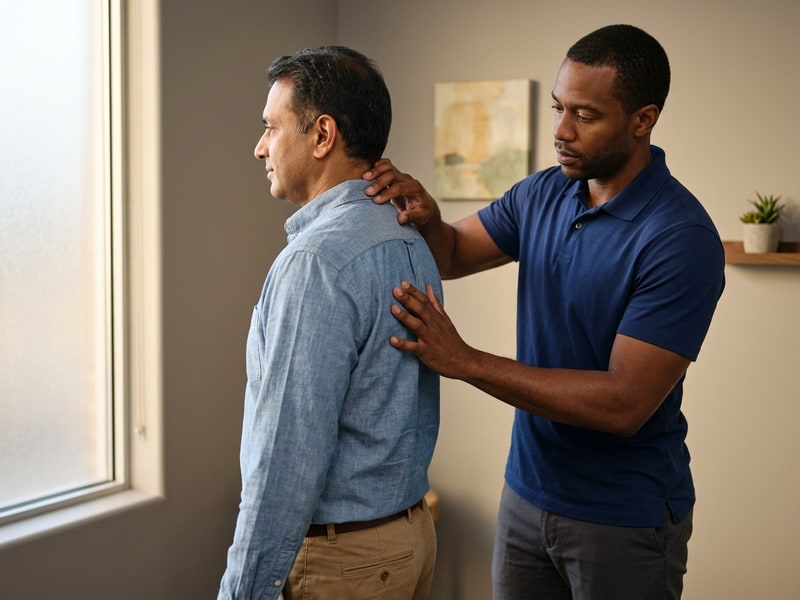
As a shoulder strain chiropractor in Ripon, my treatment usually combines adjustments to the thoracic spine and ribs, soft tissue work on the rotator cuff and pec minor, and simple exercises for scapular control. Most patients turn a corner within a few visits. Learn more about extremity care if the pain is mostly in the joint itself.
Hip Pain From Outdoor Activity: Cycling, Hiking, and Yard Days
Hip pain from outdoor activity shows up in two main groups. The first is cyclists and runners logging longer summer miles, often out along Jack Tone Road or River Road. The second is weekend warriors who spend a Saturday squatting in a garden bed, hauling mulch, or walking a job site. Both groups load the hip in a repetitive pattern their body was not ready for.
The hip is a deep ball and socket joint surrounded by powerful muscles. When one group gets tight, usually the hip flexors and TFL from sitting all week, the opposing muscles, glutes and deep rotators, get inhibited. Add a long ride or a heavy yard day, and the joint capsule and surrounding tendons get irritated. Patients describe a pinch in the front of the hip, a deep ache in the buttock, or pain on the outside of the thigh that gets worse going up stairs or getting out of a car.
I also see a fair amount of referred pain that feels like the hip but is actually coming from the low back. The sacroiliac joint and lower lumbar segments can send pain into the buttock and groin, which is why a proper exam matters before assuming a tendon problem. If you have numbness, tingling, or leg weakness, that changes the picture and you may be dealing with a nerve issue. Our sciatica page covers that in more depth, and we have a full sciatica relief guide as well.
Care for outdoor hip pain usually includes joint mobilization, targeted stretching of the hip flexors and lateral hip, and progressive strengthening of the glutes and core. I encourage patients to keep moving with modified activity rather than going flat on the couch. If you are unsure whether your pain is a muscle strain, a joint issue, or a nerve issue, come in and let us sort it out. That is what a first visit is for.
Low Back Strain: The Summer Classic in Ripon
Low back strain is the injury I treat most across every season, and summer only turns up the volume. The mechanism is almost always the same: a repetitive bending or twisting task that goes on longer than the back was conditioned for. Loading a truck with landscaping debris, pitching a slow-pitch game, water skiing on Woodward Reservoir, or lifting a cooler out of a low trunk are all common triggers.
Most summer low back strains involve the paraspinal muscles, the quadratus lumborum, and the joint capsules of the lower lumbar segments. Pain is usually across the belt line, sometimes worse on one side, and it tends to feel stiff in the morning and after sitting. If the pain shoots down the leg past the knee, or you notice weakness or loss of bladder or bowel control, that is a red flag and you need urgent medical evaluation, not a chiropractor first. Our chiropractic emergencies FAQ explains that in more detail.
For a straightforward low back strain in Ripon during summer, the evidence for combining manual therapy and exercise is solid. A review in Clinics in Sports Medicine outlined how athletes with low back pain benefit from a graded return to activity paired with hands-on care (Bono, 2002). A review in the Journal of Sport Rehabilitation looked at athletes with chronic low back pain and concluded that both lumbar joint mobilization and therapeutic exercise may improve pain and function (Dvorak and colleagues, 2011). Those studies had small samples and specific populations, so results in your case will depend on your exam, but the direction is clear.
In practice, I use adjustments, soft tissue work, and a short list of exercises the patient can do at home. Most acute strains improve meaningfully within a few weeks. For more on the low back specifically, see our lower back pain page.
What to Do in the First 48 Hours After an Outdoor Strain
The first two days after an injury set the tone for recovery. Here is the approach I give patients over the phone before they come in.
First, keep moving within a comfortable range. Total rest tends to make muscles more guarded and joints stiffer. Walking, gentle stretching, and normal daily activity are almost always better than lying on the couch. If a movement causes sharp pain, back off from that specific motion, but do not shut everything down.
Second, use ice for the first 24 to 48 hours if there is clear swelling or a sharp, hot pain. Twenty minutes on, then off, a few times a day is plenty. After the initial period, heat often feels better for muscle tightness. Neither is magic, and the research on ice versus heat is genuinely mixed, so use what makes you feel better and lets you move.
Third, hydrate and eat. Muscle tissue needs water and protein to repair. Central Valley summer heat pulls fluid out of you fast, and I regularly see cramping and delayed recovery in patients who worked outside all day on coffee and nothing else.
Fourth, know the red flags. Numbness or weakness in an arm or leg, loss of bladder or bowel control, chest pain, severe abdominal pain, or an injury after a hard fall or collision all deserve medical evaluation before chiropractic care. A trial of sports chiropractic manual therapy in semi-elite Australian Rules footballers found significantly fewer lower limb muscle strains over the season, which supports early conservative care as a reasonable path for athletes without red flags (Hoskins and Pollard, 2010). That was a specific athletic population, so it is not a guarantee for every weekend warrior, but it fits my clinical experience.
Finally, call the office if pain is not clearly improving after three or four days, or sooner if it is limiting sleep or work. Our sports injury FAQ for Central Valley athletes covers many of the questions I hear at that first visit.
How We Treat Outdoor Strains at Valley Chiropractic in Ripon
When you come in for a summer strain, we start with a real history and exam. I want to know what you were doing when it started, what makes it better or worse, and what your normal activity level looks like. I test range of motion, strength, joint mobility, and orthopedic signs to figure out which tissues are involved and whether nerves are being irritated. If something looks like it needs imaging or a referral, I will tell you.
Treatment is individualized, but most outdoor strain cases include some combination of chiropractic adjustments, soft tissue work, and exercise instruction. Adjustments restore joint motion. Soft tissue techniques calm down guarded muscles and tendons. Exercises retrain movement patterns so the same injury does not keep happening. You can see the styles of adjusting we use on our chiropractic techniques page, and a plain English breakdown in this techniques article.
For patients who want more soft tissue focus, we also offer massage therapy in the same office. Combining massage with chiropractic care often speeds up recovery from the muscular side of a strain, especially in the shoulder and low back. Athletes and active adults tend to appreciate having both options under one roof.
Visit frequency depends on the injury. A simple acute strain may need only a handful of visits. A more stubborn issue, or one layered on top of a long-standing condition, takes longer. I try to be straightforward about that early on rather than surprise you later. Costs and coverage depend on your specific plan and the type of visit, so please call the office and we will help you sort out the details.
Ripon is a small community, and I take care of neighbors, coaches, kids, and parents from around town. If you tried to push through a summer strain and it is not letting up, do not wait it out for months. Come in, get an exam, and let us build a plan. You can learn more about my background on my bio page or read why patients choose a Ripon chiropractor.
Sources
- Bono CM. Management of the athlete with low back pain. Clinics in Sports Medicine, 2002
- Dvorak H and colleagues. Effect of therapeutic exercise versus manual therapy on athletes with chronic low back pain. Journal of Sport Rehabilitation, 2011
- Neck pain: manipulating the upper back helps lessen pain and improve neck motion (patient summary). Journal of Orthopaedic and Sports Physical Therapy, 2011
- Keating C and colleagues. Short-term neurophysiological response after spinal thrust manipulation to guide return-to-throwing in collegiate pitchers. Research in Sports Medicine, 2025
- Hoskins W and Pollard H. The effect of a sports chiropractic manual therapy intervention on prevention of back pain, hamstring and lower limb injuries in semi-elite Australian Rules footballers: a randomized controlled trial. BMC Musculoskeletal Disorders, 2010