
Auto Accidents
Whiplash Mountain House: Common Questions Answered by a Local Chiropractor
By Dr. Tim Coykendall, D.C. · August 17, 2026 · Updated August 17, 2026
If you were rear-ended on I-580 or the 205 and now your neck feels stiff and sore, you likely have whiplash. As a Mountain House chiropractor, I can tell you that most whiplash cases respond well to conservative care that includes gentle spinal adjustments, guided movement, and soft tissue work, and the research supports early activity over rest. Here are the questions I hear most often from patients about whiplash in Mountain House and how I answer them in the office.
Will a chiropractor help with whiplash?
In most cases, yes. Whiplash is a soft tissue and joint injury of the neck caused by rapid back-and-forth motion, and it responds well to the kind of care chiropractors provide. Clinical guidelines from the Bone and Joint Decade Neck Pain Task Force recommend early mobilization, exercise, and manual therapy for grade I and II whiplash rather than long periods of rest or a stiff collar (Bone and Joint Decade Task Force on Neck Pain, published in Spine, 2008).
In our Mountain House office, I usually start with a careful exam of the neck, mid back, and shoulders, since crash forces rarely stop at one joint. If adjustments are appropriate, I use gentle techniques matched to how irritated the tissues are. We often add soft tissue work, light traction, and simple home exercises. Many patients also do well with massage therapy alongside chiropractic in the first few weeks.
If you want a week-by-week look at what recovery usually feels like, I wrote a companion post on the whiplash recovery timeline from week 1 through week 12. For an overview of our approach, see our whiplash treatment page and our general chiropractic care page. Not everyone needs the same plan, so the details we build in the office depend on your exam findings, imaging if warranted, and how your symptoms behave day to day.
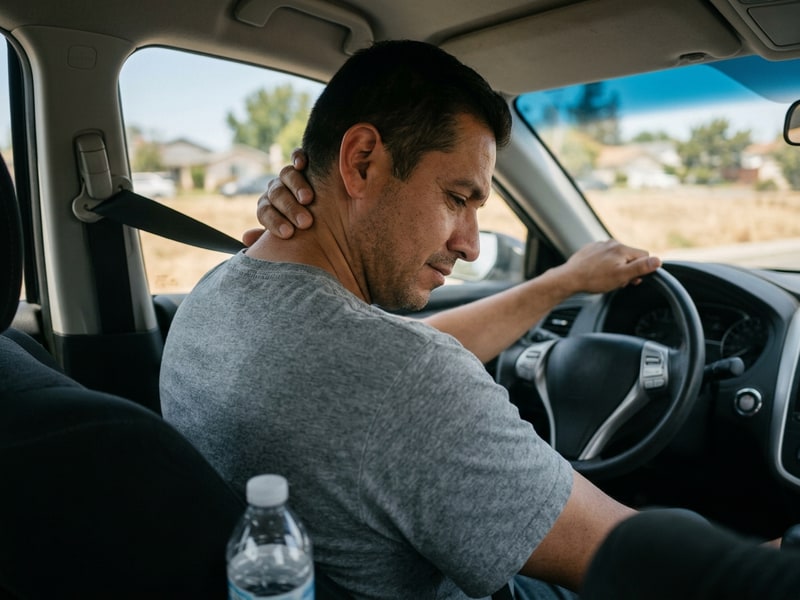
What not to do with whiplash
The first mistake I see Mountain House patients make is doing nothing at all. After a crash on the 205 or a fender bender near the Mountain House Parkway exits, it is tempting to lie on the couch and wait it out. Prolonged rest and long-term use of a soft collar are linked to slower recovery in whiplash research (NIH, National Library of Medicine review of whiplash management).
Here is what I ask patients to avoid in the first two weeks:
- Do not skip an exam because you feel “only a little sore.” Symptoms often peak 24 to 72 hours later. Our post on the first 72 hours after an auto accident walks through why.
- Do not wear a soft collar all day unless a physician specifically prescribed one.
- Do not push through heavy lifting, deep stretching, or a hard gym session in week 1.
- Do not stop moving your neck entirely. Gentle range of motion within a comfortable range is helpful.
- Do not ignore red flags like arm weakness, numbness in the hands, trouble with balance, severe headache, or changes in vision or speech. Those need urgent evaluation. See our guide on when to seek urgent care or the ER instead.
Finally, do not delay documenting the injury. If you plan to file a claim, gaps in care can complicate a personal injury case.
What kind of doctor should I see for whiplash?
For a typical whiplash without red flag symptoms, a chiropractor, a physical therapist, or a primary care doctor are all reasonable starting points. If you were in a crash, an auto accident injury chiropractor is often the fastest route to a hands-on neck exam and a plan the same week.
When should you go somewhere else first? Head to the emergency department if you have any of the following after a crash: loss of consciousness, confusion, severe or worsening headache, numbness or weakness in an arm or leg, trouble swallowing, or neck pain with high-impact mechanism and midline tenderness. Those can point to concussion, fracture, or nerve injury that need imaging before anyone touches your neck.
If your exam suggests a disc injury or a pinched nerve, we may co-manage with your primary doctor or refer for imaging. I explain more about those conditions in pinched nerve questions answered by a Tracy chiropractor and on our disc conditions page. If surgery is ever on the table, that decision belongs with you and a spine specialist. Conservative care, including chiropractic, is typically what patients try first, and surgery is usually reserved for cases with progressive neurologic loss or failure of conservative care.
If you are not sure who to call, our team at the Mountain House location can help you sort it out and point you the right direction, even if that direction is not us.
What is the most common injury from a chiropractor?
This is a fair question and I want to answer it straight. The most common side effect after a neck adjustment is short-term soreness, stiffness, or a mild headache, usually resolving within 24 hours. A systematic review in the journal Spine estimated that mild, temporary reactions occur in roughly one-third to one-half of patients after spinal manipulation, while serious adverse events are rare (Gouveia and colleagues, Spine, 2009).
The serious complication most people have heard about is cervical artery dissection, a tear in an artery in the neck that can lead to stroke. Current evidence suggests this is uncommon, and patients who experience it often have neck pain or headache from an early dissection before they ever seek care. The American Chiropractic Association supports informed consent conversations about these risks at the first visit.
In our office, I lower risk by taking a careful history, screening for vascular and neurologic red flags, and matching the technique to the patient. For an irritated whiplash neck, I often use lighter approaches like the Activator instrument or gentle mobilization instead of a classic manual thrust. You can read about those options in our post on chiropractic techniques in plain English. If any technique makes you uncomfortable, tell me and we will change it.
What a first whiplash visit in Mountain House looks like
Mountain House sits between the Altamont and Tracy, and most of my whiplash patients here are commuters. Rear-end crashes at freeway on-ramps, low-speed bumps in school pickup lines near Bethany and Wicklund, and side impacts at intersections along Grant Line Road are the ones I see most.
On a first visit, we start with your story: the crash mechanism, headrest position, seatbelt use, airbag deployment, and how the pain has moved since. Then I do an exam of the neck, jaw, shoulders, and upper back, along with orthopedic and neurologic testing. If findings suggest a fracture or nerve root injury, we refer for imaging before care begins.
If you are cleared for treatment, the first few visits focus on calming the tissues down. That may include gentle adjustments, soft tissue work, and simple home exercises. Many patients also benefit from care for related neck pain or upper back tension. If headaches are a big part of your picture, our post on when headaches need a chiropractor is worth a read.
On cost: fees depend on the visit type and your insurance. For auto accident cases in California, care is often handled through med-pay or a third-party claim. Please contact our office and we will walk you through it. You can also see our insurance FAQ for a general overview.