Chiropractic Care
Scoliosis Screening for Teens: When to Refer to a Scoliosis Chiropractor in Tracy
By Dr. Joseph Russell, D.C. · June 29, 2026 · Updated June 29, 2026
If your teen failed a school screening or you noticed an uneven shoulder line, a scoliosis chiropractor Tracy families know can help with a full spinal exam, posture analysis, and a clear referral plan if needed. Most curves found during adolescence are mild and can be monitored, but early evaluation matters because curves can progress quickly during growth spurts. At Valley Chiropractic Center, we screen, co-manage, and guide families to the right specialist when a curve crosses key thresholds.
Why Back-to-School Season Matters for Teen Spines
Every August through October, our Tracy office sees a wave of teens coming in after sports physicals and school screenings. It makes sense. Back-to-school season is when pediatricians and PE teachers take a closer look at posture, and when heavy backpacks, new sports schedules, and growth spurts collide.
Adolescent idiopathic scoliosis (AIS) is the most common form of scoliosis, affecting roughly 2 to 3 percent of children ages 10 to 16, according to the National Institute of Arthritis and Musculoskeletal and Skin Diseases. “Idiopathic” simply means we do not know the cause. What we do know is that curves often appear or worsen during the rapid growth years, which is exactly when most Tracy teens are starting middle school sports, marching band, or club volleyball.
Families in our area juggle long commutes over the Altamont, club sports in Mountain House and Manteca, and competitive academics at Tracy High and Kimball. That schedule makes it easy to miss subtle posture changes at home. A quick screening before the school year is one of the simplest ways to catch a curve early. If you want a sense of what a first appointment looks like, we walk through it on our first visit page.
Signs Parents and Coaches Should Watch For
Most teens with scoliosis have no pain at all, which is part of why it gets missed. The signs are visual, and they show up best when your teen stands with their back to you in a swimsuit or fitted tank top.
Look for these clues:
- One shoulder sitting higher than the other
- One shoulder blade sticking out more prominently
- An uneven waistline or hip that looks higher on one side
- The head not centered directly over the pelvis
- Clothes that hang unevenly, like a shirt hem that dips on one side
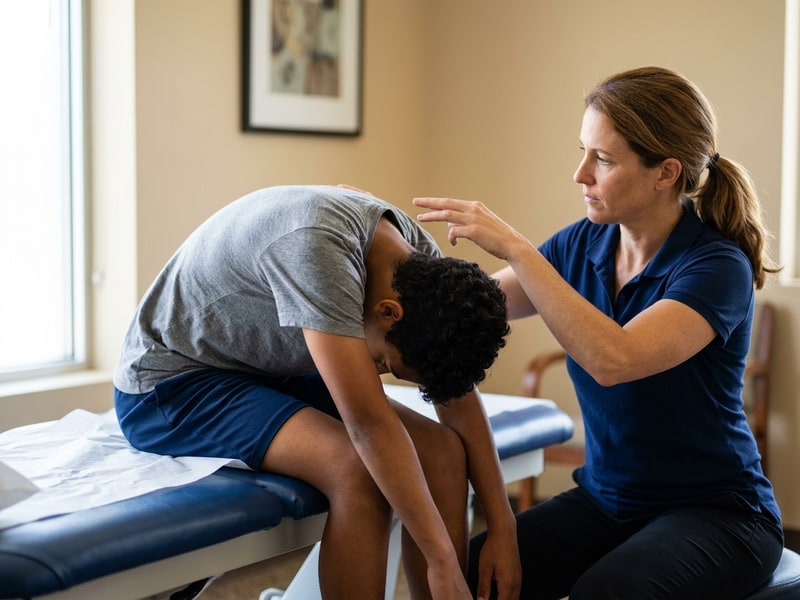
- A visible rib hump when your teen bends forward to touch their toes
That last test is called the Adam’s forward bend test, and it is the same screening tool used in most school nurse offices. The American Academy of Orthopaedic Surgeons describes it as a quick way to spot rotation in the spine.
Coaches often notice asymmetry before parents do, because they watch teens move from every angle. If a club volleyball or baseball coach mentions that your child seems to favor one side, lean during squats, or have trouble holding a symmetric posture, take it seriously. That same observation applies to teens dealing with mid-back or upper-back tightness that does not resolve with rest.
What Actually Happens at a Scoliosis Evaluation
When a parent brings a teen to our Tracy office with a screening concern, the visit is calm and conversational. No surprises. We start with a health history, including questions about menstrual onset for girls (a key marker for skeletal maturity), family history of scoliosis, growth patterns, and any sports or activities.
Next comes the physical exam. I use the Adam’s forward bend test along with a scoliometer, a small tool that measures trunk rotation in degrees. A reading of 7 degrees or more typically warrants imaging, which aligns with guidance from the Scoliosis Research Society. I also check leg length, hip alignment, shoulder height, and how the spine moves through flexion, extension, and side bending.
If the exam suggests a meaningful curve, we discuss imaging. Standing X-rays are the gold standard for measuring the Cobb angle, which is how scoliosis severity is graded. Curves under 10 degrees are considered postural asymmetry, not true scoliosis. Curves of 10 to 25 degrees are mild and usually monitored. Curves of 25 to 40 degrees often need bracing, and curves over 40 to 50 degrees may need surgical consultation.
Our job at this stage is to give families a clear picture of where their teen falls, what to monitor, and who else should be involved. You can learn more about how we approach this on our scoliosis service page.
When to Refer: Thresholds That Matter
Not every curve needs a specialist, and not every teen needs ongoing care. Here is the framework I use when deciding whether to refer out, co-manage, or monitor in-office.
Monitor in our office: Curves under 20 degrees in a teen who is still growing, with no pain and no rapid progression. We re-screen every 4 to 6 months, work on posture, core strength, and movement quality, and watch for changes.
Co-manage with a pediatric orthopedist: Curves of 20 to 40 degrees, especially in a teen with significant growth remaining. Bracing may be recommended by the orthopedist, and chiropractic care can support comfort, mobility, and posture alongside the brace. The landmark BrAIST study published in the New England Journal of Medicine showed that bracing significantly reduces the risk of curve progression to surgical thresholds.
Refer to a pediatric spine surgeon: Curves over 40 to 45 degrees, rapid progression of more than 5 degrees in 6 months, or curves with neurological symptoms like leg weakness or changes in bowel and bladder function.
Parents sometimes ask me if chiropractic is a scoliosis brace alternative. The honest answer is no, not for moderate to severe curves. Bracing has decades of evidence behind it. What chiropractic care does well is support the teen through the process, address pain and stiffness, and keep them moving. For families also dealing with sports injuries or pediatric chiropractic needs, we coordinate everything in one place.
How Chiropractic Care Supports Teens with Scoliosis
Let me be clear about what chiropractic can and cannot do. We cannot straighten an idiopathic scoliotic curve through adjustments alone. No conservative care can. What we can do is help your teen feel better, move better, and stay active.
Here is what teen scoliosis care looks like at our office:
- Gentle spinal adjustments to improve mobility in stiff segments above and below the curve
- Scoliosis exercises based on the principles of Schroth method and active self-correction, focused on breathing, asymmetric strengthening, and postural awareness
- Soft tissue work for the muscles that overwork on one side of the curve
- Hip and shoulder mobility work to address compensations that develop over time
- Backpack, desk, and sleep posture coaching for Tracy students who carry heavy loads or sit through long study sessions
A 2014 systematic review in Scoliosis and Spinal Disorders found that physiotherapeutic scoliosis-specific exercises can be a useful adjunct for AIS patients, particularly for posture, pain, and quality of life. We use those same principles in our care plans.
We see teens from across the valley, including families who drive in from our Mountain House, Manteca, and Ripon offices. If your teen has been told they have a curve, or you are simply not sure, an evaluation is the right next step.
Sources
- National Institute of Arthritis and Musculoskeletal and Skin Diseases: Scoliosis
- Weinstein et al., Effects of Bracing in Adolescents with Idiopathic Scoliosis (BrAIST), New England Journal of Medicine
- American Academy of Orthopaedic Surgeons: Idiopathic Scoliosis in Children and Adolescents
- Romano et al., Exercises for adolescent idiopathic scoliosis, Scoliosis and Spinal Disorders