
Pain Management
Sciatica Treatment Tracy: What Actually Works and What to Skip
By Dr. Joseph Russell, D.C. · October 13, 2026 · Updated October 13, 2026
Effective sciatica treatment in Tracy usually combines spinal manipulation, targeted movement, short-term pain control, and patient education. Rest in bed, repeated opioid use, and chasing passive gadgets are the parts most people should skip. If you have progressive weakness, loss of bowel or bladder control, or saddle numbness, skip the clinic and go to the emergency room.
What Sciatica Actually Is (and Why Tracy Patients Get It)
Sciatica is not a diagnosis. It is a symptom pattern. The sciatic nerve runs from your lower back through the buttock and down the leg. When a nearby structure irritates one of the nerve roots that feed it, you get pain, tingling, or weakness that travels past the knee. Most cases trace back to a lumbar disc bulge or herniation, bone spurs narrowing the nerve opening, or tight muscles pressing on the nerve path.
In my Tracy office, I see a few patterns over and over. The first is the commuter. Tracy sends thousands of people over the Altamont every morning, and sitting for 60 to 90 minutes each way loads the lower discs. The second is the warehouse worker. The distribution centers along 205 and 11th Street keep a lot of our neighbors on their feet lifting all day. The third is the weekend yard warrior who spends Saturday hauling bags of mulch after sitting all week.
Age matters too. Younger patients, roughly 25 to 45, tend to show up with disc-related sciatica. Older patients more often have stenosis, where the nerve tunnel narrows from arthritis. The treatment plan is not identical for those two groups, which is why a careful exam matters before anyone adjusts you or hands you an exercise sheet.
If your leg pain started after a car crash on I-205 or 580, that is a different animal, and documentation matters for both your health and any claim. We cover that workflow on our auto accident injury page. For a deeper look at the condition itself, our sciatica service page walks through anatomy and the exam process in more detail. The point here is simple: good sciatica care starts with figuring out which structure is actually angry.
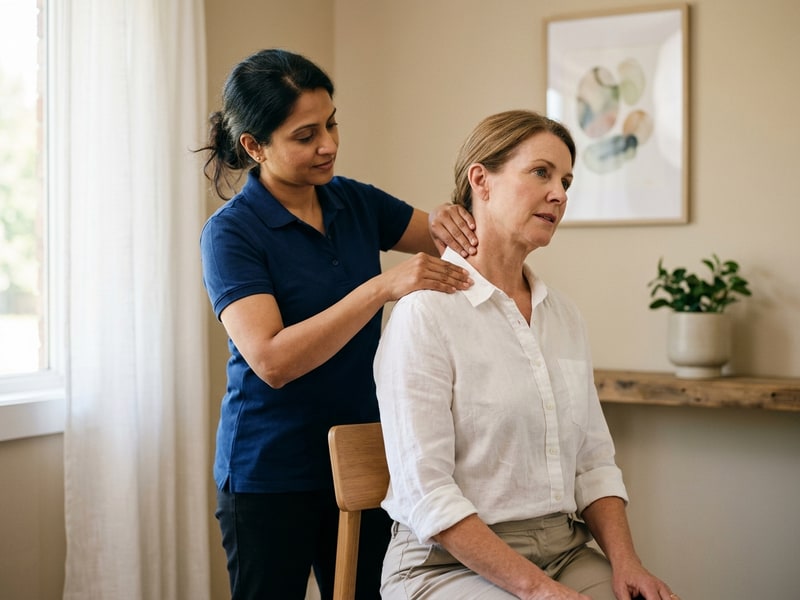
What Actually Works: Evidence-Based Sciatica Care
Let’s talk about what the research actually supports. A 2023 systematic review of clinical practice guidelines for low back pain with and without radiculopathy found that guidelines consistently recommend exercise, education, and manual therapy as first-line care, with medication playing a smaller role than many patients expect (Archives of PM&R, 2023). That is a shift from how a lot of us were treated ten or fifteen years ago.
Spinal manipulation, which is the main tool a sciatica chiropractor in Tracy uses, has moderate evidence behind it for chronic low back pain. A BMJ systematic review and meta-analysis of randomized controlled trials found spinal manipulative therapy produced modest improvements in pain and function compared with other recommended therapies, with musculoskeletal soreness being the most common side effect (BMJ, 2019). A broader 2024 review in the Journal of Clinical Medicine looked at where chiropractic fits in current guidelines and confirmed manipulation is recommended as part of a multimodal plan for low back and neck pain (J Clin Med, 2024).
For sciatic nerve pain relief in Tracy, I generally combine four things:
- Spinal manipulation or mobilization matched to the exam findings
- Specific nerve-glide and directional-preference exercises you do daily at home
- Soft tissue work on the glutes, piriformis, and lumbar paraspinals
- Clear activity guidance, not a sheet of rules that sends you to bed
I also screen hips and feet. A stiff hip or a collapsed arch changes how force travels up the chain, and ignoring that is why some people keep flaring. If an extremity issue is driving things, we address it through extremity care. Most uncomplicated cases improve meaningfully within a few weeks of consistent care, though your actual timeline depends on how long the problem has been building.
What to Skip (or at Least Be Skeptical About)
Here is the harder conversation. A lot of popular sciatica advice is either outdated or oversold.
Strict bed rest. This one still comes up, and it is wrong for almost every case. Lying flat for days stiffens the back, weakens the hips, and often makes nerve pain worse when you finally stand up. Modified activity beats bed rest.
Long courses of opioids. A 2024 systematic review of clinical practice guidelines for lumbosacral radiculopathy found that most guidelines recommend against routine use of opioids and discourage gabapentinoids as a default, favoring short-term NSAIDs when medication is used at all (PM&R, 2024). That lines up with what I see clinically. Opioids may blunt pain for a day, but they do not fix the mechanical problem, and the rebound is rough.
Passive-only treatment forever. Lying on a traction table or heat pack with no active component may feel nice, but research supports a mix of hands-on care and active rehab, not endless passive sessions. If a plan does not include exercises you do at home, ask why.
Aggressive stretching into pain. Hamstring stretches that reproduce your leg pain are not therapy, they are a flare. Nerve tissue does not love being yanked.
Imaging on day one for everyone. If you do not have red flags, early MRI often shows findings that are not the actual pain generator and can push people toward procedures they did not need. Guidelines reserve early imaging for suspected serious pathology or progressive neurologic loss.
Chasing viral TikTok fixes. The “one weird stretch” videos usually show a cat-cow or a pigeon pose. They are fine as part of a program, but they are not a plan on their own. For a related rundown, see our FAQ on the worst things you can do for sciatica pain.
How Chiropractic Fits In for Disc-Related Sciatica
Most of the sciatica I treat in Tracy traces back to a lumbar disc. That raises a fair question from patients: is adjusting safe when a disc is involved? For most non-emergency presentations, yes, when the technique is matched to the exam.
A Cochrane review of spinal manipulative therapy for chronic low back pain found manipulation produced small to moderate short-term benefits for pain and function, similar in size to other common treatments, with a low risk of serious adverse events (Cochrane, 2011). An older literature synthesis in the Journal of Manipulative and Physiological Therapeutics looked specifically at low back pain with leg complaints and found reasonable evidence that chiropractic care helps a meaningful share of patients with radiating leg pain (JMPT, 2008).
None of this makes chiropractic care a replacement for a surgical opinion. If your exam or imaging suggests you may be a surgical candidate, that decision belongs with you and a spine surgeon, and I will refer you. What a non surgical sciatica treatment plan in Tracy can do is give conservative care the fair, structured trial that current guidelines recommend for non-emergency cases before anyone talks about procedures.
We tailor the adjustment style to the patient. Some people do well with a traditional diversified adjustment. Others respond better to lower-force work with an Activator or drop table. Our chiropractic techniques page explains those options, and our write-up on disc conditions covers how we modify care when imaging shows a herniation.
Sciatica Exercises Tracy Patients Can Start at Home
You do not need a gym membership or a $400 lumbar gadget. A few basic movements, done consistently, do more than most of what you can buy. Start gently. Stop any movement that sends sharp pain down the leg or makes numbness worse.
-
Prone press-up. Lie face down, hands under shoulders, and slowly press your chest up while your hips stay on the floor. Hold two seconds, lower, repeat 10 times. For many disc-related cases, this centralizes pain back toward the spine, which is a good sign.
-
Nerve floss (seated). Sit tall. Straighten one knee while you look up, then bend the knee as you tuck your chin. Smooth and slow, 10 reps per side. This is a glide, not a stretch, so you should not feel a hard pull.
-
Glute bridge. On your back, knees bent, feet flat. Squeeze your glutes and lift your hips. Hold three seconds, lower, 10 reps. Hip strength takes load off the lower back.
-
Dead bug. On your back, arms up, knees bent at 90. Lower the opposite arm and leg slowly while keeping your lower back flat. 8 reps per side.
-
Walking. Short, frequent walks beat one long walk. Three 10-minute walks a day is a reasonable starting dose. Tracy has good flat loops around Lincoln Park and the trails near the Grant Line corridor.
Two rules. First, if a movement reproduces your leg pain past the knee, back off and tell your chiropractor. Second, give any routine two weeks before judging it. Nerves are slow to calm down.
If you commute daily, pair these with posture resets at your desk. Our post on posture fixes for remote workers and the lower back pain overview have more details. For deeper questions, the sciatica FAQs page is a good next read.
When to See a Sciatica Specialist in Tracy, CA, and When to Go to the ER
Most sciatica is not an emergency, but a few symptoms are. Go to the emergency room, not the chiropractor, if you have any of these:
- Loss of bowel or bladder control, or sudden difficulty urinating
- Numbness in the groin or inner thighs (saddle area)
- Progressive weakness in a leg, like a foot that is starting to drag
- Severe leg pain after a serious fall or crash
Those can signal cauda equina syndrome or a significant nerve injury, and they need urgent imaging. Our chiropractic emergencies FAQ spells this out in more detail.
Short of those red flags, see a sciatica chiropractor in Tracy when:
- Leg pain has lasted more than a week and is not improving
- Pain wakes you at night or limits sitting, standing, or walking
- You have had sciatica flares before and want to get ahead of this one
- You tried rest and over-the-counter medication without relief
At your first visit, expect a real history, orthopedic and neurologic testing, and a conversation about what we found before anyone adjusts you. If your exam suggests you need imaging or a specialist opinion, I will tell you. I refer out when it is the right call. Co-management with primary care, pain management, or a spine surgeon is normal and healthy.
We see patients from all over the area. Our main Tracy office covers most of the city, and we also have locations in Mountain House, Manteca, and Ripon if those are closer to your work. If you would like to meet the team first, you can read more about my background on my bio page. Fees depend on the visit and your insurance, so call the office and we will walk through it with you. The goal is simple: get you moving, get the nerve calm, and keep it that way.
Sources
- A Systematic Review of Clinical Practice Guidelines for Non-specific Low Back Pain With and Without Radiculopathy, Archives of PM&R, 2023
- Benefits and harms of spinal manipulative therapy for chronic low back pain, BMJ, 2019
- Medication recommendations for lumbosacral radiculopathy, PM&R, 2024
- Spinal manipulative therapy for chronic low-back pain, Cochrane Database, 2011
- Chiropractic management of low back pain and low back-related leg complaints, JMPT, 2008
- Chiropractic and Spinal Manipulation: Research Trends and Guideline Recommendations, J Clin Med, 2024