
Pain Management
Sciatica From Driving in Manteca: How to Prevent and Treat Nerve Pain on Long Summer Trips
By Dr. Johannes Garrido, D.C. · September 14, 2026 · Updated September 14, 2026
Sciatica from driving in Manteca usually flares because a car seat holds your hips lower than your knees, tips your pelvis backward, and puts steady pressure on the sciatic nerve as it runs through the buttock and down the leg. The fix is a mix of better seat setup, short movement breaks every 60 to 90 minutes, and targeted care when the pain lingers past a few days. This guide walks through prevention, in-car adjustments, and when to see a sciatica chiropractor in Manteca.
Why Long Drives Trigger Sciatica for Manteca Travelers
Summer in Manteca means road trips. Families load up for Yosemite, Tahoe, the coast, or the long haul down I-5 to Southern California. Local commuters already rack up windshield time heading to the Bay Area or Sacramento, and adding a vacation drive on top of that daily grind is often the tipping point for sciatic nerve pain.
Here is what actually happens to your body in a car seat. Most seats bucket your pelvis into a slight backward tilt, which flattens the natural curve in your low back. That posture increases pressure on the lumbar discs, and it stretches the piriformis muscle in your buttock over the sciatic nerve. Add vibration from the road, a wallet in the back pocket, and a cruise-control leg held in one position for hours, and you have a recipe for lower back pain that shoots into the leg.
Genetics play a role in who ends up with disc problems in the first place. A 2022 review in Clinical Anatomy summarized the growing evidence that intervertebral disc degeneration has a strong hereditary component, which helps explain why two people with the same commute can have very different outcomes (Genetics of intervertebral disc disease).
Driving does not usually cause a disc problem out of nowhere. What it does is expose a spine that is already sensitive. A disc bulge at L4 to L5 or L5 to S1 that was quiet at home suddenly becomes loud after four hours on I-580. The sciatic nerve gets irritated, and pain, tingling, or numbness travels from the low back through the buttock and down the back of the thigh. Sometimes it reaches the calf or foot. Knowing this pattern is the first step to preventing it on your next trip.
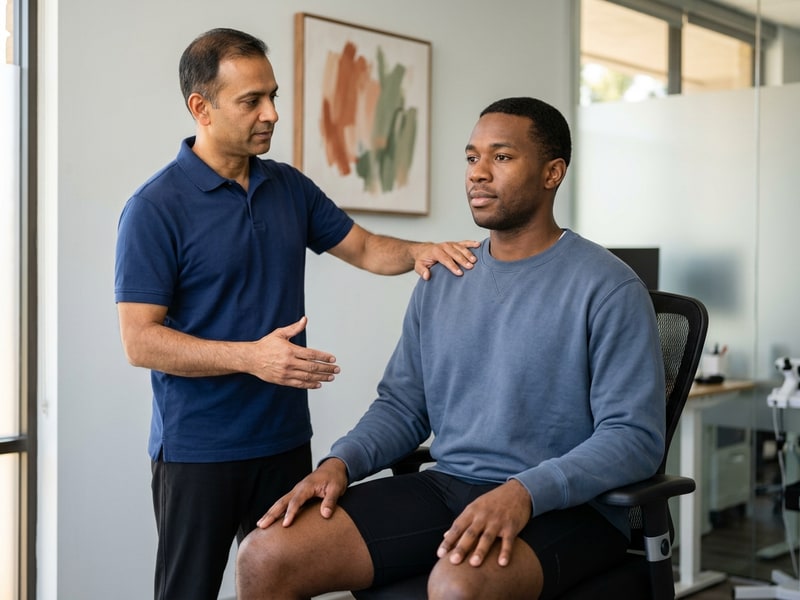
Set Up Your Car Seat to Protect the Sciatic Nerve
Long drive sciatica prevention starts before you leave the driveway. Spend five minutes on your seat position and you will feel the difference by the Altamont Pass.
Start with seat height. Raise the seat so your hips are level with, or slightly above, your knees. If your hips sink below your knees, your pelvis rolls backward and your low back rounds. That is the exact position that aggravates the sciatic nerve. If your car will not go high enough, add a firm wedge cushion.
Next, the seat back. Most people recline too far. Aim for a back angle around 100 to 110 degrees, close to upright but not stiff. This keeps your head over your shoulders instead of jutting forward, and it lets your low back rest against the seat rather than hanging in space.
The lumbar support matters. If your car has an adjustable lumbar, dial it in so you feel gentle contact at your belt line. If it does not, roll up a small towel and place it in the small of your back. You want support, not a bulge that pushes you forward.
Check the distance to the pedals. Your knees should be slightly bent when the pedal is pressed to the floor. Sitting too far back forces you to reach with your right leg, which loads the same side where sciatica most often shows up.
Empty your back pockets. A wallet under one buttock tilts your pelvis and directly compresses the piriformis and sciatic nerve. This is one of the simplest changes I ask Manteca patients to make, and it often takes the edge off within a day. Small setup choices add up over a 400 mile drive.
Movement Breaks and In-Car Habits That Actually Help
Even a perfect seat setup will not save you if you drive for six hours without moving. Muscles get stiff, discs lose fluid exchange, and nerves get cranky. The single most useful habit for driving nerve pain in Manteca travelers is a real movement break every 60 to 90 minutes.
A real break is not a gas pump lean. Get out, walk for three to five minutes, and do a few simple movements. I coach patients on three:
- Standing back extensions. Hands on hips, gently arch backward five to ten times. This helps counter all the flexion you just did in the seat.
- Hip flexor stretch. Step one foot forward into a mini lunge, tuck your tailbone, and hold 20 to 30 seconds per side. Tight hip flexors pull on the low back and feed sciatic pain.
- Piriformis stretch against the car. Cross your ankle over the opposite knee, sit back into a slight squat against the door, and hold 20 to 30 seconds each side.
Between stops, use small in-car resets. Every 15 or 20 minutes, do a pelvic tilt. Press your low back gently into the seat, then release. Ten reps takes fifteen seconds and keeps the segments moving. Shift your weight from one sit bone to the other. Roll your shoulders. Change your right foot position when you are on cruise control.
Hydration matters more than people think. Discs are mostly water, and they need fluid to handle load. Coffee alone will not do it. Bring a water bottle and sip regularly. Yes, you will stop more often. That is the point.
If you are the passenger, do not just sink into the seat with a phone. The same setup rules apply. Reclining fully with a laptop on your lap for three hours is a classic setup for post-trip sciatica that shows up the next morning.
When Sciatica Hits on the Road: First Steps and Red Flags
Sometimes prevention comes too late and the nerve pain shows up mid-trip. Here is how to handle it without making things worse.
First, do not power through eight more hours. Pull off at the next safe stop and walk. Movement is almost always better than more sitting. Ice for 15 minutes on the low back or buttock can calm an angry nerve. Heat feels good on tight muscles but can sometimes puff up an irritated disc, so I usually start with ice for the first day or two.
Over-the-counter anti-inflammatories help some people short term. A 2024 randomized controlled trial in Postgraduate Medical Journal gave emergency department patients with acute low back pain and sciatica diclofenac plus tramadol, tizanidine, or placebo, and found that adding tramadol or tizanidine did not improve functional recovery over diclofenac alone (Comparison of diclofenac with tramadol, tizanidine or placebo). Check with your pharmacist or physician before mixing anything with your current medications.
Most mid-trip sciatica flares will settle down within a few days with movement, position changes, and time. But some symptoms mean you need to stop the trip and get evaluated in person, not push through to the next hotel:
- Sudden weakness in the leg or foot, especially foot drop where you cannot lift the toes
- Numbness in the groin or inner thighs (saddle area)
- Loss of control of bladder or bowel
- Severe pain that is not relieved by any position change
These can point to serious nerve compression that needs urgent medical attention, not chiropractic care first. Our chiropractic emergencies guide walks through when the ER is the right call. For everyone else, the rule of thumb is simple: if leg pain from a drive is not clearly better within a week, get evaluated.
Chiropractic Care for Post-Trip Sciatica in Manteca
When you get home from the trip and the pain is still traveling down your leg, that is a good time to see a sciatica chiropractor in Manteca. The goal of care is to calm the irritated nerve, restore movement in the low back and pelvis, and give you exercises so the same thing does not happen on the next trip.
A first visit at our office starts with a real history and exam. I want to know your drive length, seat setup, prior back history, and where the pain travels. I test reflexes, strength, sensation, and nerve tension. If red flags show up, I refer out. If it looks like mechanical sciatica from a disc or joint irritation, we start conservative care. Our sciatica service page explains what a typical care plan looks like.
Evidence supports pairing hands-on care with active exercise. A preplanned subgroup analysis published in The Spine Journal looked at patients with lumbar disc herniation and radiculopathy and found that individualized functional restoration added to advice produced meaningful improvements compared with advice alone in that subgroup (Individualized functional restoration as an adjunct to advice). This is a single subgroup analysis with the usual limitations, but it lines up with what I see in the office: adjustments and movement retraining together work better than either alone.
Electrodiagnostic testing occasionally comes up. A 2015 European Spine Journal study looked at the prognostic value of EMG and nerve conduction testing in sciatica patients getting physical therapy and found the results helped predict outcomes in some cases (The prognostic value of electrodiagnostic testing). Most Manteca patients will not need it, but I mention it because it exists as a next step if progress stalls.
Care is not one-size-fits-all. Some patients respond in a handful of visits. Others with a disc component take longer. We also offer massage therapy as an adjunct for the muscular side of sciatica, and I coordinate care across our Manteca, Ripon, Tracy, and Mountain House offices.
Building a Sciatica-Resistant Body for Future Trips
Once the pain settles, the work is not done. Sciatica has a habit of returning if the underlying setup does not change. Long-term sciatica road trip relief comes from a stronger, more mobile body that tolerates sitting better.
Three simple habits move the needle for most driving-heavy patients:
First, daily hip mobility. Hips that do not extend force the low back to pick up the slack. Five minutes a day of hip flexor stretches, glute bridges, and a gentle spinal extension routine goes a long way. I give patients a printed home program at their second visit.
Second, glute and core strengthening. Weak glutes are a huge driver of sciatic and hip pain. A 2003 Iowa Orthopaedic Journal paper on hip abductor pain syndrome laid out the rationale for targeting the gluteus medius and surrounding hip stabilizers to reduce lower quarter pain patterns (Rationale for treatment of hip abductor pain syndrome). Side-lying leg raises, clamshells, and single-leg bridges are easy places to start.
Third, planned maintenance. If you drive to the Bay Area three days a week and then head out on a road trip once a month, your spine deserves the same maintenance you give your car. Some patients come in every few weeks for a tune-up, especially before a big trip. This is what preventative care looks like for a driving-heavy lifestyle.
A few more Manteca-specific tips. Highway 99 and I-205 have a lot of expansion joints that produce constant low-level vibration, which fatigues the low back faster than smooth pavement. Plan your stop schedule accordingly. If you are heading to the coast through Livermore or Altamont, the elevation changes and lane shifts add micro-adjustments that tire the paraspinal muscles. And if you are hauling a trailer or bikes, your posture shifts to compensate. All of these are reasons to build a stronger baseline. For related reading, our lower back pain guide for Mountain House commuters covers a lot of the same territory from the daily-commute angle.
Sources
- Genetics of intervertebral disc disease: A review (Clinical Anatomy, 2022)
- Comparison of diclofenac with tramadol, tizanidine or placebo in acute low back pain and sciatica (Postgraduate Medical Journal, 2024)
- Individualized functional restoration as an adjunct to advice for lumbar disc herniation with radiculopathy (The Spine Journal, 2017)
- The prognostic value of electrodiagnostic testing in patients with sciatica (European Spine Journal, 2015)
- Rationale for treatment of hip abductor pain syndrome (Iowa Orthopaedic Journal, 2003)